The Scribe’s Advantage

The Scribe’s Advantage · Companion

The Field Guide

Dragons, caves, gates, rivers and the four piles: the book’s whole vocabulary, drawn and defined in its own words.


88 entries · 22 plates · each entry gives the chapter where the term first appears

01 · The four ages

Dragons

Wherever surplus collects long enough to be sorted, something forms to sort it, and that something is the dragon. A dragon is not a curse. A dragon is what sorting looks like at scale. Dragons also age, and the book keeps track of four ages.

“The dragon breathes on the surplus. All dragons breathe, from the day they are born, and the breath is nothing sinister; it is the warmth of a body that has eaten well, the productive use of what the river brought. Where the breath lands, the surplus changes state.”

Prologue

The breath cycle

Scroll. One dragon grows through its four ages, breathing on the river’s surplus at each one, and then walks the adult’s road: a claw on the door, clenching, the bite, and the ouroboros.

  1. Spears rust · Bread is eaten

    Age 1 of 4

    Baby

    “A baby dragon breathes on bread and spears and nothing else: a leader, a structure, maybe a religion, and no pile worth sorting beyond the next meal and the next fight.”

    Prologue

    Two piles. The breath lands on the surplus the river washed up, and it turns into bread and spears.

  2. Spears rust · Bread is eaten · Gilt evaporates

    Age 2 of 4

    Young

    “A young dragon adds gilt: palaces, king lists, statues, a court that can look like a civilization in full bloom and has no bench of scribes to carry anything forward.”

    Prologue

    Three piles. Watch the gilt: it glitters, and it evaporates.

  3. Spears rust · Bread is eaten · Gilt evaporates · Treasure compounds

    Age 3 of 4

    Adult

    “An adult dragon is defined by one thing, treasure. The moment a dragon starts minting, writing things down and building the schools and copying rooms that compound one generation’s knowledge into the next, it has crossed the threshold, and there is no crossing back.”

    Prologue

    Spears rust, bread is eaten, gilt evaporates, and treasure compounds. Each breath adds to the treasure; nothing else keeps.

  4. Spears rust · Bread is eaten · Gilt evaporates · Treasure compounds

    Age 4 of 4

    Wise elder

    “The fourth age is the wise elder, an adult that learned to show its treasure and trade from it instead of sitting on it, and built machinery on purpose to keep its own doors open.”

    Prologue

    Its treasure goes back out through the open door. The book’s Field Guide calls this compound interest on its own hoard.

  5. The adult’s road · 1

    A claw on the door

    “Limiting is not a wall, just a claw resting on the door, but it starts a road.”

    Prologue

    The choice lives in the adult: leave the gates open, or start limiting who is allowed to compound.

  6. The adult’s road · 2

    Clenching

    “As the hoard grows the dragon is drawn to clench, the claws tightening on the door and the body curving around the treasure, and a clenching dragon is drawn to bite.”

    Prologue

    A clenched claw can still be pried open.

  7. The adult’s road · 3

    The bite

    “The bite is a moment: the dragon clamps down and links its body into a ring. After it, the dragon’s own body is the dam. The door is still down there somewhere, under the coils.”

    Prologue

    Upstream, the river pools behind the body. Downstream, it runs thin.

  8. The adult’s road · 4

    Ouroboros

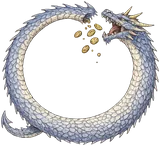
    “The ring that closes is the ouroboros, the adult curled so far inward that it is facing its own tail: nothing in, nothing out, the beast coiled on its hoard, mistaking the coil for greatness.”

    Prologue

    The breath stops reaching anything new. It is the default, and it is terminal.

DragonAuthor’s Note
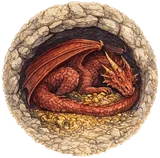
The sorting system itself, born the first day the pile is bigger than the appetite, deciding which mouths the surplus feeds: soldiers, courtiers, clerks and road gangs, or a scribe at a bench. It is not a monster from outside, and not what a preservation system turns into when it goes bad; every society with a pile worth sorting has one. A dragon is not a curse. A dragon is what sorting looks like at scale.
ExampleThe man in Uruk walked a world where the first dragon had just opened its eyes, and the first thing it did was count (Chapter 1).
Figure 16: The Dragon’s Postures
Four agesPrologue
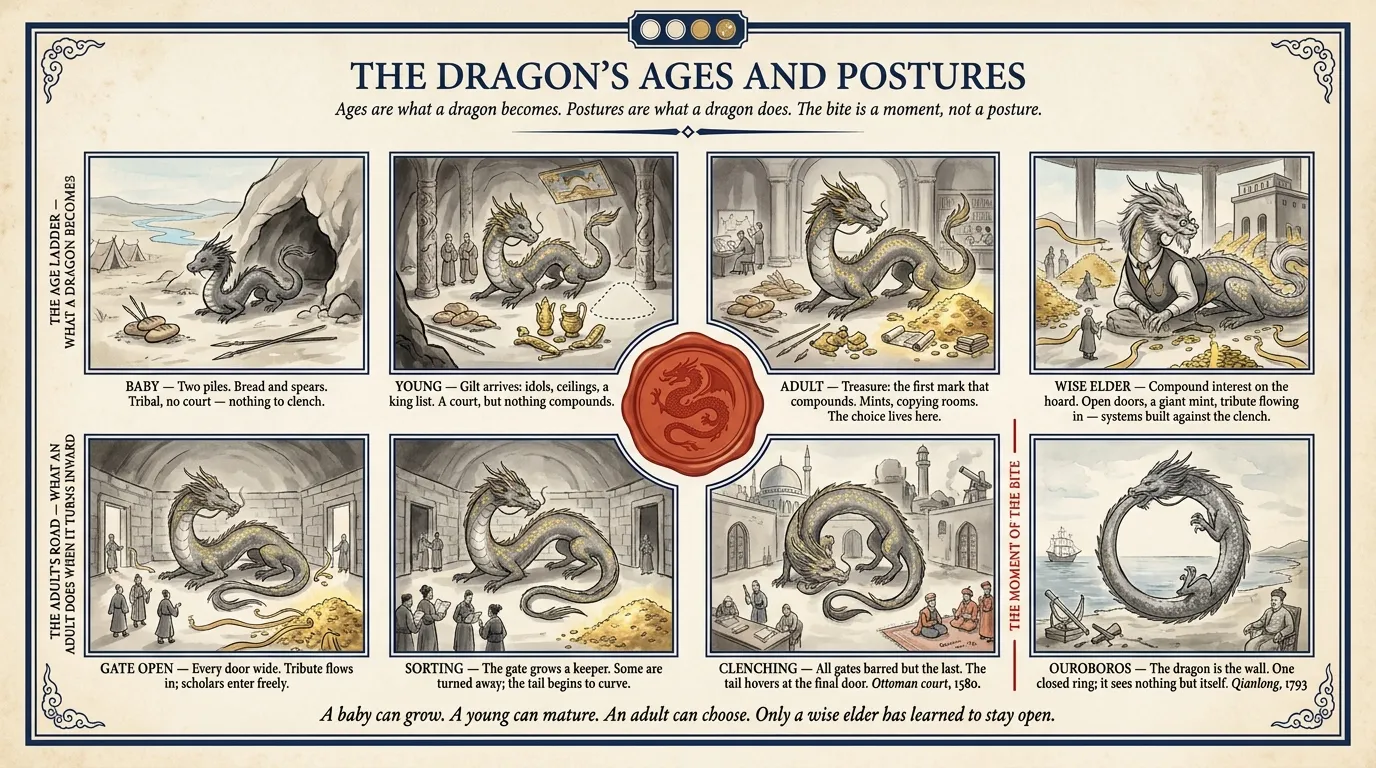
Dragons age, and the book keeps track of four ages: baby, young, adult and wise elder. Size does not win: a large young dragon loses to a smaller adult, given time, every time, because compounding outruns scale.
Figure 16: The Dragon’s Postures
Baby dragonPrologue
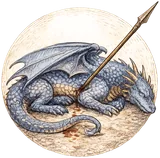
The first age. It breathes on bread and spears and nothing else: a leader, a structure, maybe a religion, and no pile worth sorting beyond the next meal and the next fight. When a baby loses its river it gets no line on the scorecard; it did not meet a fate, it never formed.
ExampleThe Comanche took the horse from Spanish stock and built a mounted empire the size of modern France, but a warrior who found a better way to break a horse could teach it only by riding alongside his sons (Chapter 7).
Figure 16: The Dragon’s Postures
Young dragonPrologue
The second age. It breathes on bread, spears and gilt: palaces, ceremonies, king lists, statues, a court that can look like a civilization in full bloom, and no bench of scribes to carry anything forward. Most of the Bronze Age was young dragons.
ExampleMycenae had gilt enough to fill a grave and never a bench of scribes, and not one of its clerks outlived the fire (Prologue).
Figure 16: The Dragon’s Postures
Adult dragonPrologue
The third age, defined by one thing: treasure. The moment a dragon starts minting, writing things down and building the schools and copying rooms that compound one generation’s knowledge into the next, it has crossed the threshold, and there is no crossing back. The adult is where the choice lives: leave its gates open, or start limiting who is allowed to compound.
ExampleUruk was a young dragon the morning it started counting; the day the count outlived the counter, it crossed, and became the first adult in the record (Chapter 1).
Figure 16: The Dragon’s Postures
Wise elderPrologue
The fourth age: an adult that learned to show its treasure and trade from it instead of sitting on it, and built machinery on purpose to keep its own doors open. The Abbasids, the Song, Florence and Alfred’s Wessex each held the age for a while and lost it; Britain in 1854 was the first to make it permanent by statute, and America assembled one by accident. China today is an adult on a managed-burn schedule, not an elder. A wise elder is not immune to the ouroboros; it knows what its tail tastes like.
ExampleBritain looked at China’s examination system and imported only the filter, and that is how the first permanent wise elder was built by statute: not by killing the dragon but by teaching it to breathe with the doors open (Chapter 16).
Figure 16: The Dragon’s Postures
BreathPrologue
What every dragon does from the day it is born: the warmth of a body that has eaten well, the productive use of what the river brought. It is nothing sinister. Where the breath lands, the surplus changes state.
ExampleAt Uruk the barley needed counting, the count needed a mark, and the mark outlived the barley: the breath fell on the ledger because the ledger was where the grain was (Chapter 1).
ForgeCh 1
Where the dragon works the surplus. The only productive fire in this book went out with its smith, Ötzi; every heat after that is breath. What comes off the forge lands on the four piles, and most of it is bread.
ExampleÖtzi had a forge, a real one, charcoal and green rock and copper at 99.7 percent, and when his breath stopped the recipe went into the ice with him: that is the difference between a forge and a dragon (Chapter 1).
SmeltingCh 1
The breath landing on the surplus and changing its state: a heap of barley turned into a mark that outlives the barley, the counter and the temple. Nobody chose it. The temple at Uruk was doing it before anyone inside the walls had a word for it.
Greater sortingCh 8
The dragon’s choice one level up from the gate: whether the extra goes to the writing that breeds, to soldiers, to its own palace, or to the next day’s bread. It is still a sorting of people: deciding where the money goes is deciding which mouths the surplus feeds. Its marks do not fade.
ExampleAn appropriations bill is the greater sorting written down annually, and the NSF line is a record of the sorting you can read without a genome lab (Chapter 20).
HoardPrologue
Whatever a dragon is holding in its cave, all four piles together. Only time tells the piles apart, and the dragon does not live on that timescale. It knows one thing: the hoard is bigger than last year.
ExampleConstantinople held the Greek canon for a thousand years, showed nothing, and never collected a coin of it; Florence showed everything, and five cities bid against each other for the same Greek teachers (Chapter 12).
Figure 8: The Four Piles
Claw marksPrologue
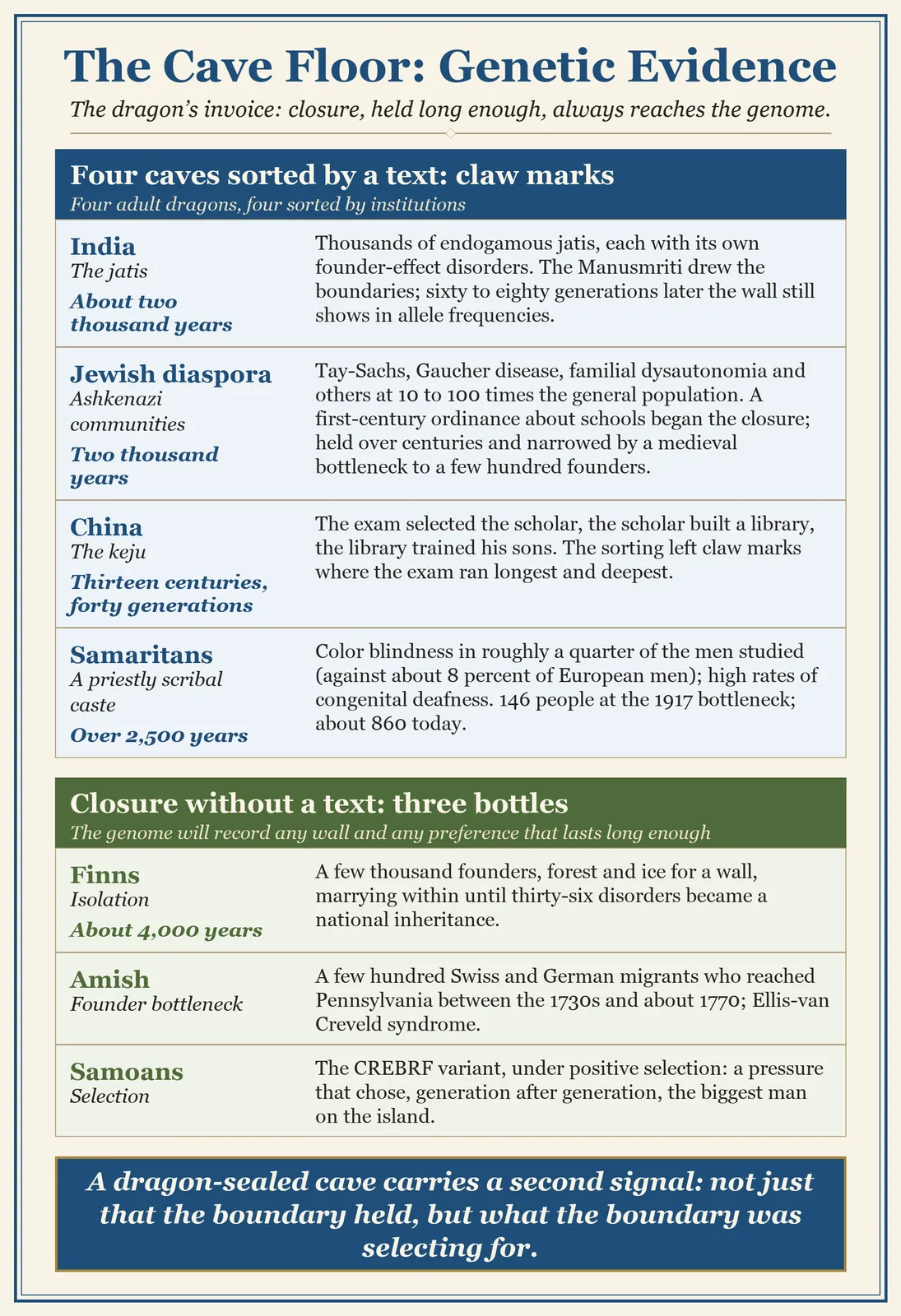
What the dragon’s sorting leaves in the genome: the selection that long closure writes into a population’s DNA, and the genetic diseases that prove it reached that deep. The genome is where the dragon leaves its claw marks, not the forge that does the work.
ExampleThe Samaritans, whose priestly caste has copied its Torah by hand for over 2,500 years, are the smallest cave in the genetic case list and the deepest claw marks: color blindness in roughly a quarter of the men studied (Chapter 5).
Figure 4: The Cave Floor, Genetic Evidence
The dragon’s invoiceCh 5
Closure, held long enough, always reaches the genome. A dragon-sealed cave carries a second signal: not just that the boundary held, but what the boundary was selecting for.
Figure 4: The Cave Floor, Genetic Evidence
LegacyCh 14
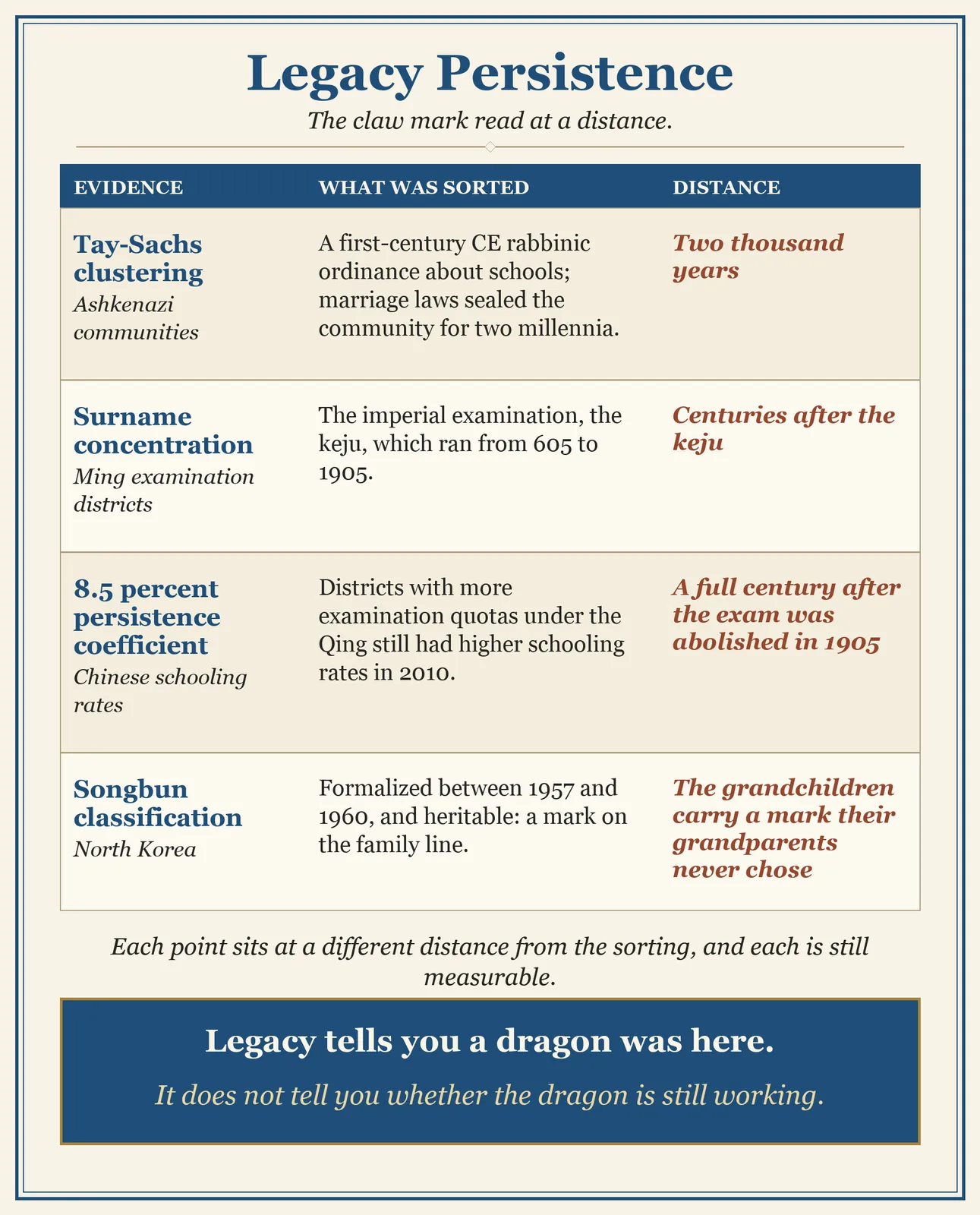
The dragon’s sorting, written into populations and persisting long after the institution that did the sorting is gone.
ExampleChinese schooling rates still carry an 8.5 percent persistence coefficient a full century after the examination was abolished (Chapter 14).
Figure 17: Legacy Persistence

02 · A moment and an end

The Bite and the Ouroboros

The wall is made of scribes. The bite happens when the knowledge class, the very people the surplus was spent to create, takes over the gate from the inside and becomes it. Open, clenching, the bite, ouroboros: those are the four postures, and only an adult can reach the last one, because only an adult has a treasure to guard.

Clenching: the claws tightening on the door, the body curving around the treasure. A clenched claw can still be pried open.

The bite is a moment: the dragon clamps down and links its body into a ring.

The ouroboros: its own body is one round wall around the treasure, nothing in, nothing out. It is terminal, and it is the default: where an adult goes if nothing interrupts it.

“And the ring that closes is the ouroboros, the adult curled so far inward that it is facing its own tail: nothing in, nothing out, the beast coiled on its hoard, mistaking the coil for greatness. … The ouroboros is not a disaster that befalls a dragon. It is where an adult goes if nothing interrupts it. It is the default, and it is terminal.”

Prologue
The bitePrologue
A moment, not a stage: the dragon clamps down and links its body into a ring, and after it the dragon’s own body is the dam. It happens when the knowledge class, the people whose one job was to mint the treasure, takes over the gate from the inside and becomes it. For China the date is 1487, the year the canon outlived every teacher who could still explain why it was written.
ExampleIn 1487 the Eight-Legged Essay became the mandatory examination format, and it was used without interruption until 1901: 414 years of mandated form (Chapter 9).
Figure 10: Gate, Dam, and the Dimensions of the Flood
OuroborosPrologue
The fourth posture and the end of the road: the adult curled so far inward that it is facing its own tail, its own body one round wall around the treasure, nothing in, nothing out. It is not a disaster that befalls a dragon; it is where an adult goes if nothing interrupts it. It is the default, and it is terminal.
ExampleEgypt, the oldest case, kept an unbroken literate tradition for three thousand years and spent the last two thousand of them copying the same training texts, the errors handed down as faithfully as the wisdom (Prologue).
Figure 16: The Dragon’s Postures
The scribe’s advantagePrologue
The wall is made of scribes. The scribe is the treasure pile walking around on two legs, and the scribe is also what the wall gets built from. That double identity is the scribe’s advantage, and it is also the scribe’s indictment.
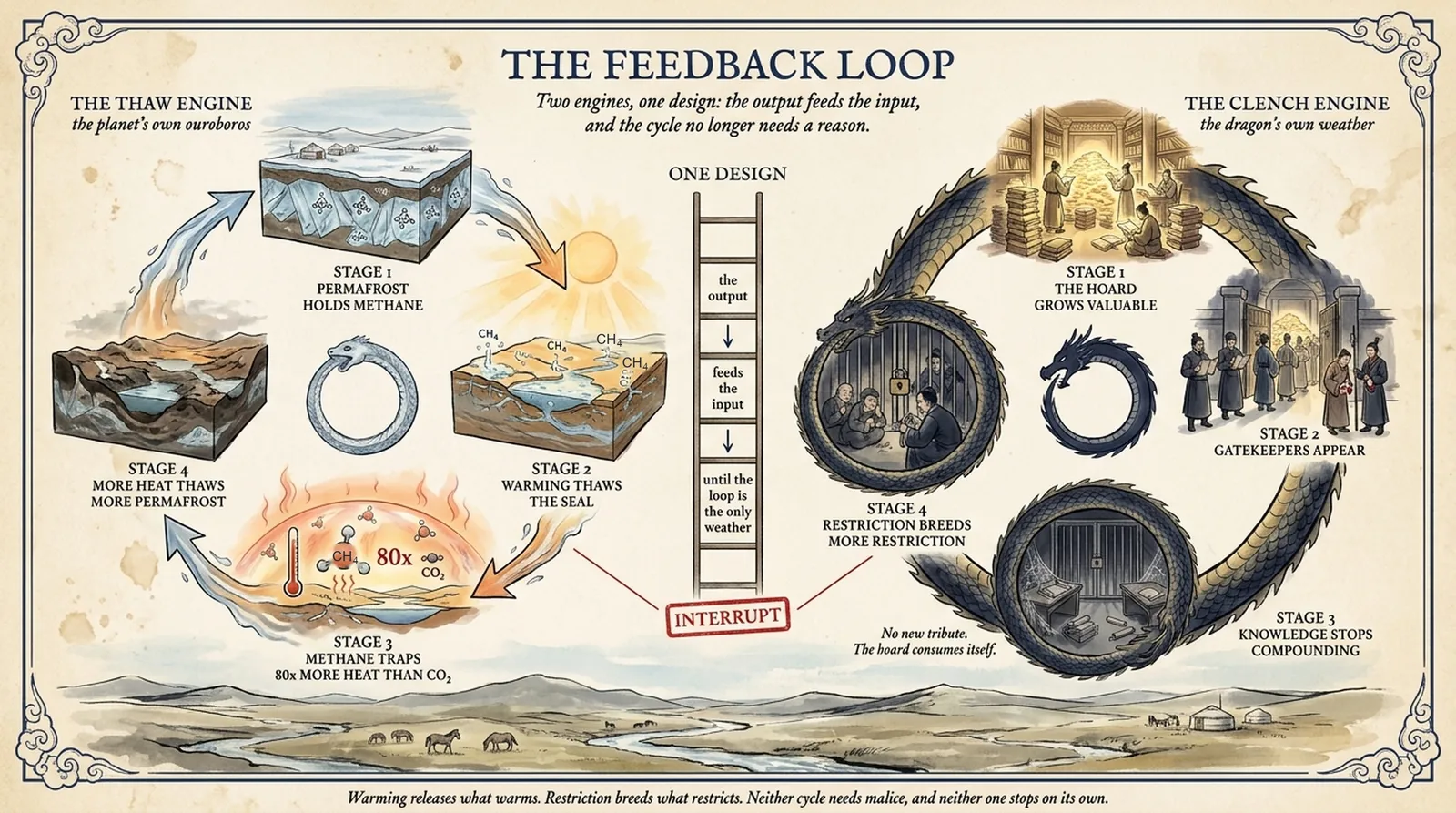
Clench EngineCh 22
The dragon’s own weather. The hoard grows valuable. Gatekeepers appear. Knowledge stops compounding. Restriction breeds more restriction.
Figure 20: The Feedback Loop
Thaw EngineCh 22
The planet’s own ouroboros: permafrost holds methane, warming thaws the seal, and more heat thaws more permafrost. It runs on the same design as the Clench Engine. Neither cycle needs malice. Neither one stops on its own.
Figure 20: The Feedback Loop

03 · Where surplus piles up

Caves

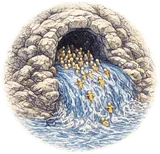
The river runs, and where it runs long enough over stable ground, surplus washes up. Where it piles up it hollows out a space: the cave. When a dragon conquers its neighbors, their caves open into its own; when the empire breaks, the tunnels seal and the small caves come back. Caves nest, too.

The cave: where the surplus piles up

  1. Muckcomes from the dragon
  2. Siltcomes from the river
  3. Rotcomes from time alone

Tell them apart by what they bury. Muck buries people. Silt buries the treasure, and buries it from the reader rather than from the world. Rot needs no current and no dragon, only enough years.

CaveAuthor’s Note
The space surplus hollows out where it piles up, and the ground the pile reaches: the territory one dragon sorts. Draw a line around every field whose barley comes through one gate and you have drawn a cave. Every surplus makes one, whether anyone inside it ever writes a word.
TunnelsPrologue
When a dragon conquers its neighbors, their caves open into its own, and the tunnels between them stay open for as long as it can hold them. When the empire breaks, the tunnels seal and the small caves come back.
ExampleWhen Akkad fell, the tunnels sealed and the city caves came back, each with its own dragon at the mouth again (Chapter 1).
Nested cavesPrologue
Caves nest. Nevada’s cave sits inside America’s, with its own hoard and its own gates.
ExampleIn 1931 America was forty-eight states, each with its own courts and its own gates, the borders between them held open by a constitution that let a woman carry herself from New York into Nevada on a train ticket (Chapter 3).
Cave systemPrologue
Caves nest. When a dragon conquers its neighbors their caves open into its own, joined by tunnels that stay open as long as it can hold them. America is the modern case: fifty caves under one dragon, the tunnels held open by a constitution, so that to kill it you would have to collapse every cave at once.
ExampleA thousand years after the first Uruk tablet, Sargon of Akkad took the city caves of the Sumerian plain and connected them into one cave system under one dragon, the first in the record (Chapter 1).
Cave floorCh 5
The genome, read as the ground of the cave where the dragon left its mark. The claw marks on the cave floor prove the dragon was real the way nothing else can, because an imaginary beast does not leave dead children.
Figure 4: The Cave Floor, Genetic Evidence
Baby’s caveCh 7
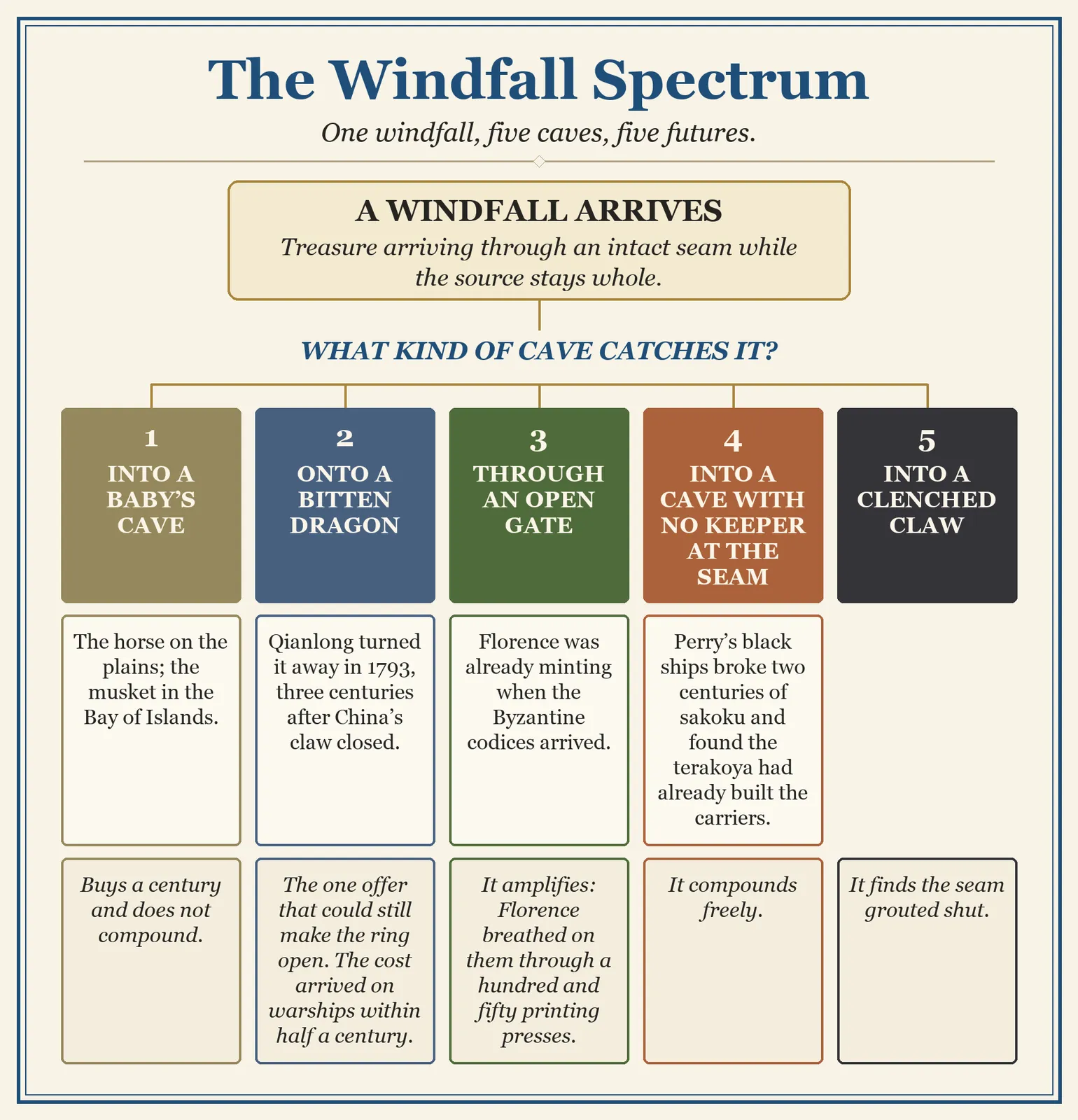
The cave of a dragon with no treasure pile. A windfall that lands in a baby’s cave buys a century and does not compound: the horse on the plains, the musket in the Bay of Islands.
Figure 7: The Windfall Spectrum
RefugiaPrologue
The pockets the fire missed: the seed banks, the roots that went deep enough to survive. A society’s scribes are its refugia. When they survive, the civilization regrows.
ExampleTimbuktu’s manuscripts, 350,000 of them smuggled out in footlockers by road and river between 2012 and early 2013, are the modern proof that the refugia mechanism is a thing humans do whenever transmission is attacked (Chapter 12).
CorridorCh 4
A connection that carries knowledge between caves. The same connections that carry knowledge carry the shock, and the tighter the ties, the faster the flood travels: a corridor does not check the cargo.
ExampleThe same corridors that had carried the Encyclopédie carried the French Revolution across Europe (Chapter 23).
Figure 12: Pipeline vs. Network
SeamCh 7
The join where knowledge from outside enters a cave. An intact seam lets treasure in without anyone dying for it; a clenched claw grouts it shut.
ExamplePerry’s black ships broke two centuries of sakoku and found the terakoya had already built the carriers, with no keeper at the seam and nobody standing between them and the new treasure (Chapter 7).
Figure 7: The Windfall Spectrum
WindfallCh 7
Treasure arriving through an intact seam while the source stays whole, which is what a corridor delivers when the seam holds. Nobody died for the Phoenician letters to reach Greece. What a windfall becomes depends entirely on the cave that catches it.
ExampleThe muskets the Ngapuhi chief Hongi Hika carried home after sailing to England in 1820 were a windfall, and in a baby’s cave they bought a century and did not compound (Chapter 7).
Figure 7: The Windfall Spectrum
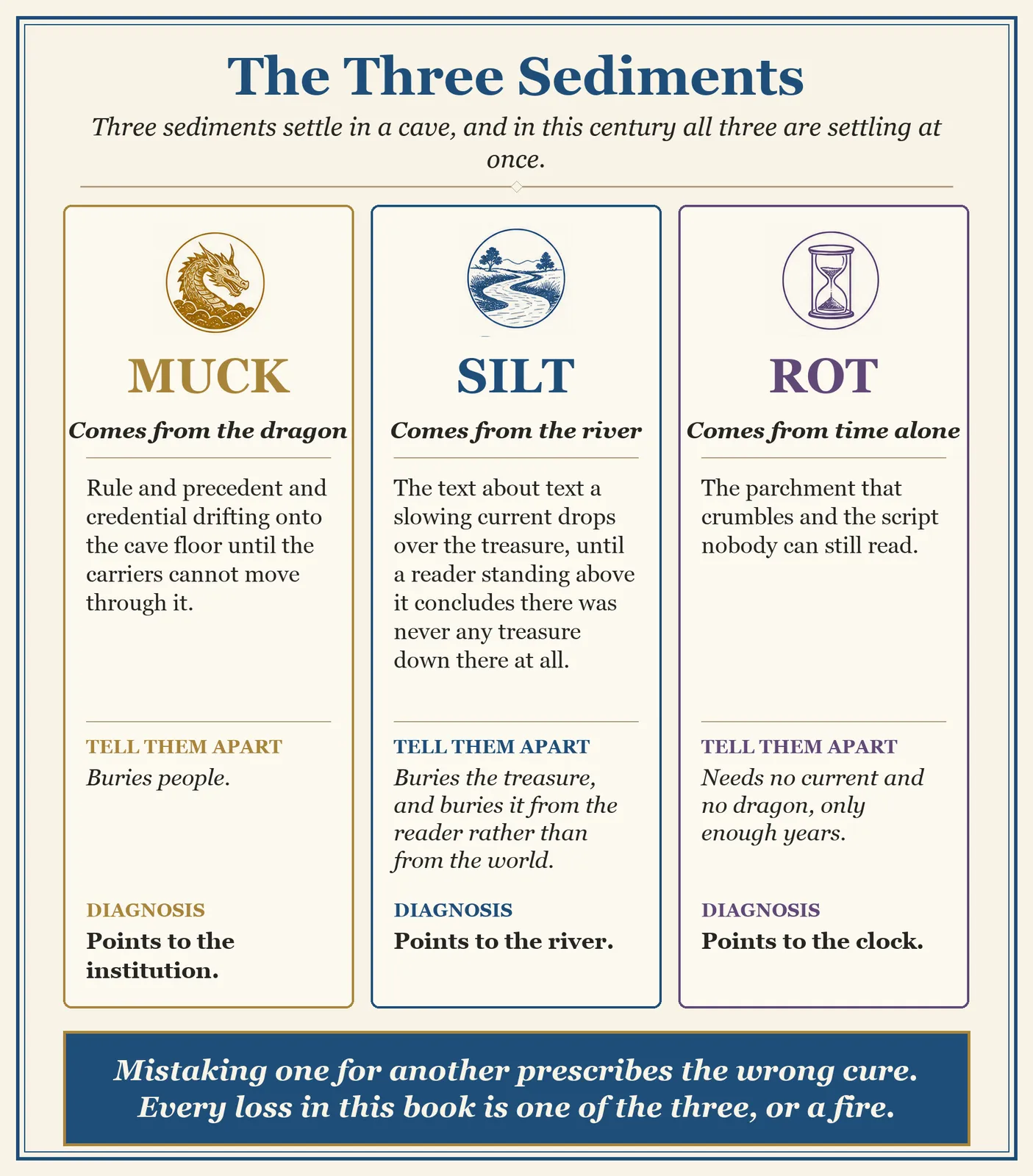
Three sedimentsCh 23
Muck, silt, and rot. Three sediments settle in a cave, and in this century all three are settling at once. Tell them apart by what they bury.
Figure 21: The Three Sediments
MuckCh 23
Comes from the dragon: rule and precedent and credential drifting onto the cave floor until the carriers cannot move through it. Muck buries people.
Figure 21: The Three Sediments
SiltCh 23
Comes from the river: the text about text a slowing current drops over the treasure, until a reader standing above it concludes there was never any treasure down there at all.
Figure 21: The Three Sediments
RotCh 23
Comes from time alone: the parchment that crumbles and the script nobody can still read. Rot needs no current and no dragon, only enough years.
Figure 21: The Three Sediments
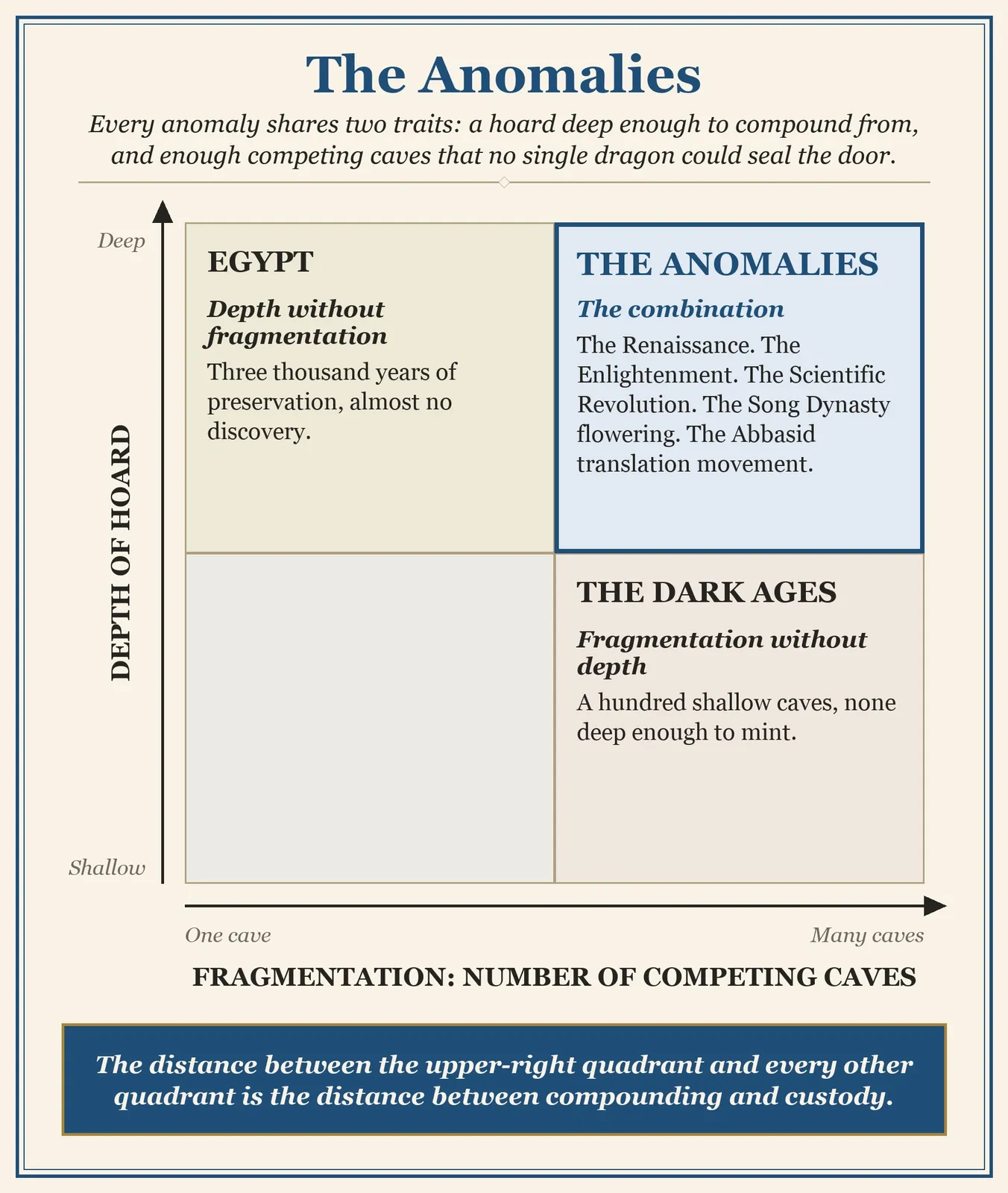
AnomalyCh 8
Every anomaly in the record shares two traits: a hoard deep enough to compound from, and enough competing caves that no single dragon could seal the door.
ExampleThe depth without the fragmentation is Egypt, the fragmentation without the depth is the dark ages, and the combination is the Renaissance (Chapter 8).
Figure 9: The Anomalies
04 · Two states of one system

Gates and Dams

Sorting means a gate. The gate is the door at the mouth of the cave, and the dragon’s claw opens it and closes it. After the bite, the dragon’s own body is the dam. The gate and the dam are two states of one system, and the door is still down there somewhere, under the coils.

The claw clenches on the gate

Open

An open dragon is not a dragon without a door; it is a dragon holding the door wide. Trade flowing, knowledge moving, scribes working in the open where anyone can watch and some can join.

A claw on the door

Limiting is not a wall, just a claw resting on the door, but it starts a road. The gate grows a keeper, and some are turned away.

Clenching

The claws tightening on the door as the hoard grows. A clenched claw can still be pried open.

The body becomes the dam

the gatethe river

The gate

The gate is the sorting door the dragon operates with its claws. The river still runs through the cave.

THE MOMENT OF THE BITE

The bite

The bite is a moment: the dragon clamps down and links its body into a ring.

upstream:the river poolsdownstream:the drought

The dam

The dam is the dragon’s own body, after it has stopped operating the door and become the barrier itself. The door is still down there somewhere, under the coils.

GateAuthor’s Note
The door at the mouth of the cave, worked by the dragon’s claw. Its job is not whether treasure gets made at all; its job is what share of the children standing in the river are let anywhere near a bench and a stylus. Every dragon keeps one: an open dragon is not a dragon without a door, it is a dragon holding the door wide.
ExampleAt Uruk the gate came after the hoard: the temple kept a keeper, and the keeper chose who sat behind the ledge and who walked back through the courtyard with an empty donkey (Chapter 1).
Figure 10: Gate, Dam, and the Dimensions of the Flood
DamPrologue
The dragon’s own body, after the bite, when it has stopped operating the door and become the barrier itself. The gate and the dam are two states of one system, and the door is still down there somewhere, under the coils.
ExampleThe Ming examination became a dam: every rejected candidate was water with nowhere to go, and the keju dammed the river of a civilization (Chapter 9).
Figure 10: Gate, Dam, and the Dimensions of the Flood
ClawPrologue
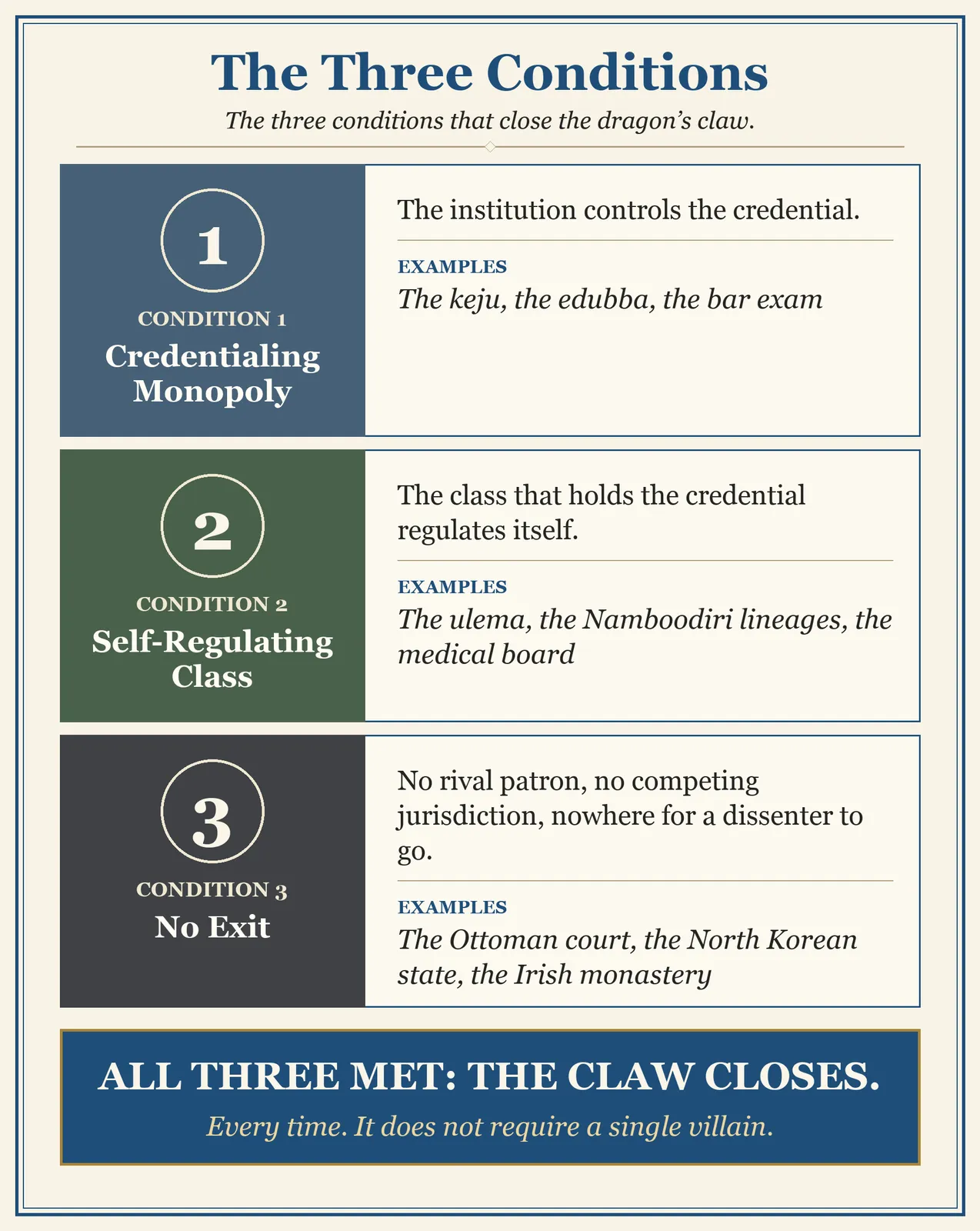
The part of the dragon that acts on the gate, opening it and closing it; three conditions close it. Limiting is not a wall, just a claw resting on the door, but it starts a road: as the hoard grows the dragon is drawn to clench. A clenched claw can be pried open. Nobody has ever argued with a wall.
Figure 1: The Three Conditions
Three conditionsPrologue
What closes the claw: the institution controls the credential, the class that holds the credential regulates itself, and there is no exit. Hit all three and the claw closes, every time, and it does not require a single villain.
ExampleMesopotamia met all three: the edubba held a credentialing monopoly, the scribal class policed itself under the man in charge of Sumerian and the man in charge of the whip, and no competing scribal jurisdiction existed (Chapter 8).
Figure 1: The Three Conditions
Overcomable gatePrologue
A gate whose toll is high but payable by someone born outside the literate class. It can be beaten or outlived: not the absence of sorting, but sorting with an exit. The Song dynasty sealed the names on every examination paper and had clerks recopy each one so no grader could tell whose it was.
ExampleAbraham Lincoln borrowed the books and was admitted to the Illinois bar in 1836 without a day of law school (Prologue).
Cultural gatePrologue
A gate made of birth, not effort: the keeper turns you away for what you are. Caste is the pure case; one ancient Indian law text prescribes molten tin poured into the ears of a laborer who overhears the sacred verses. Gender in a plow society is the vast case. The dragon did not build it, but it kept it everywhere, because it is the cheapest gate ever operated.
ExampleIn plow Europe the crop built the body requirement, the body requirement built the inheritance rule, and France’s Salic law barred women from the throne and from inheriting landed property at all (Chapter 2).
Institutional gatePrologue
The dragon’s own masonry: the dragon decides who sits the exam, writes the questions, and grades the answers. Mesopotamia’s tablet house admitted the sons of governors, priests and scribes; the medieval university charged an entry fee in Latin; imperial China is the type specimen.
ExampleIn medieval Europe the gate itself was the Latin, and the license, and the doctrine that the plow boy did not need to know, and the Church operated it for a thousand years (Chapter 15).
HardeningPrologue
Gates harden in one direction only: overcomable to cultural to institutional, toll to birth to law. When you see a gate change kinds you are watching a grip begin to close.
ExampleIn the Islamic world the personal ijaza hardened into an institutional credential as the madrasa became the sole channel (Chapter 15).
Flood ratioCh 9
The claw’s sharpness: candidates against seats. Four hundred thousand Ming candidates against two hundred seats per cycle is a flood ratio of two thousand to one.
Figure 10: Gate, Dam, and the Dimensions of the Flood
Bank heightCh 9
Carriers against the people they serve. Three thousand active jinshi serving a hundred and fifty million is a bank height of two carriers per hundred thousand people.
Figure 10: Gate, Dam, and the Dimensions of the Flood
Bank hardnessCh 9
Soft banks flex before they break; Britain re-cut its banks by statute in 1854 and survived it. The Ming banks were hard, and hard banks break before they flex.
Figure 10: Gate, Dam, and the Dimensions of the Flood
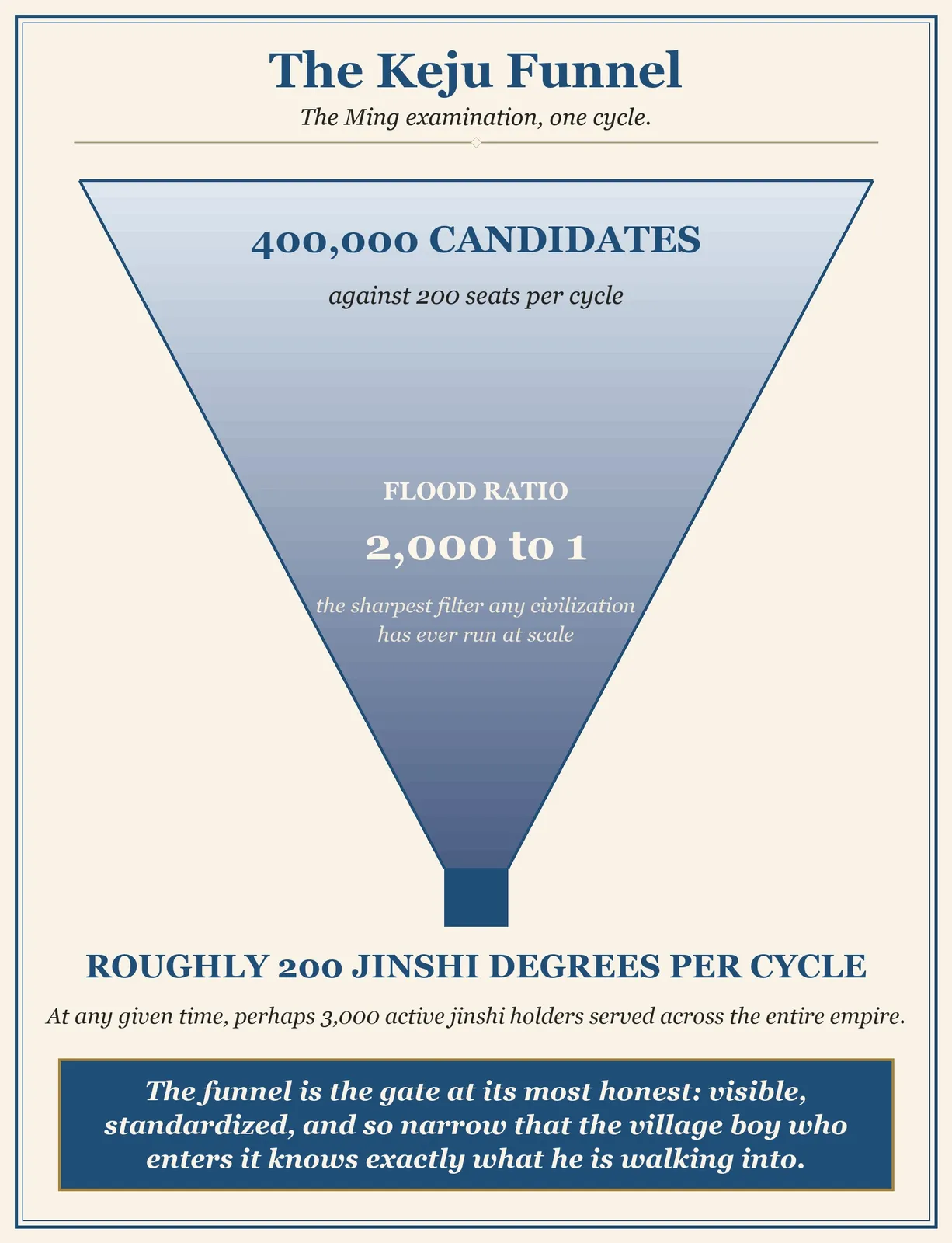
Keju funnelCh 9
Four hundred thousand boys enter. About two hundred pass. The funnel is the gate at its most honest: visible, standardized, and narrow. The gate that does not show you its numbers is the one to worry about.
Figure 11: The Keju Funnel

05 · Carriers, record, stolen rivers

Rivers

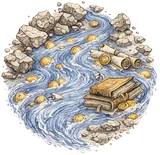
The river is not the Tigris. The river is the people and the surplus they carry, running together as one current. Geography is the ground it runs over, deciding where surplus pools and a cave forms.

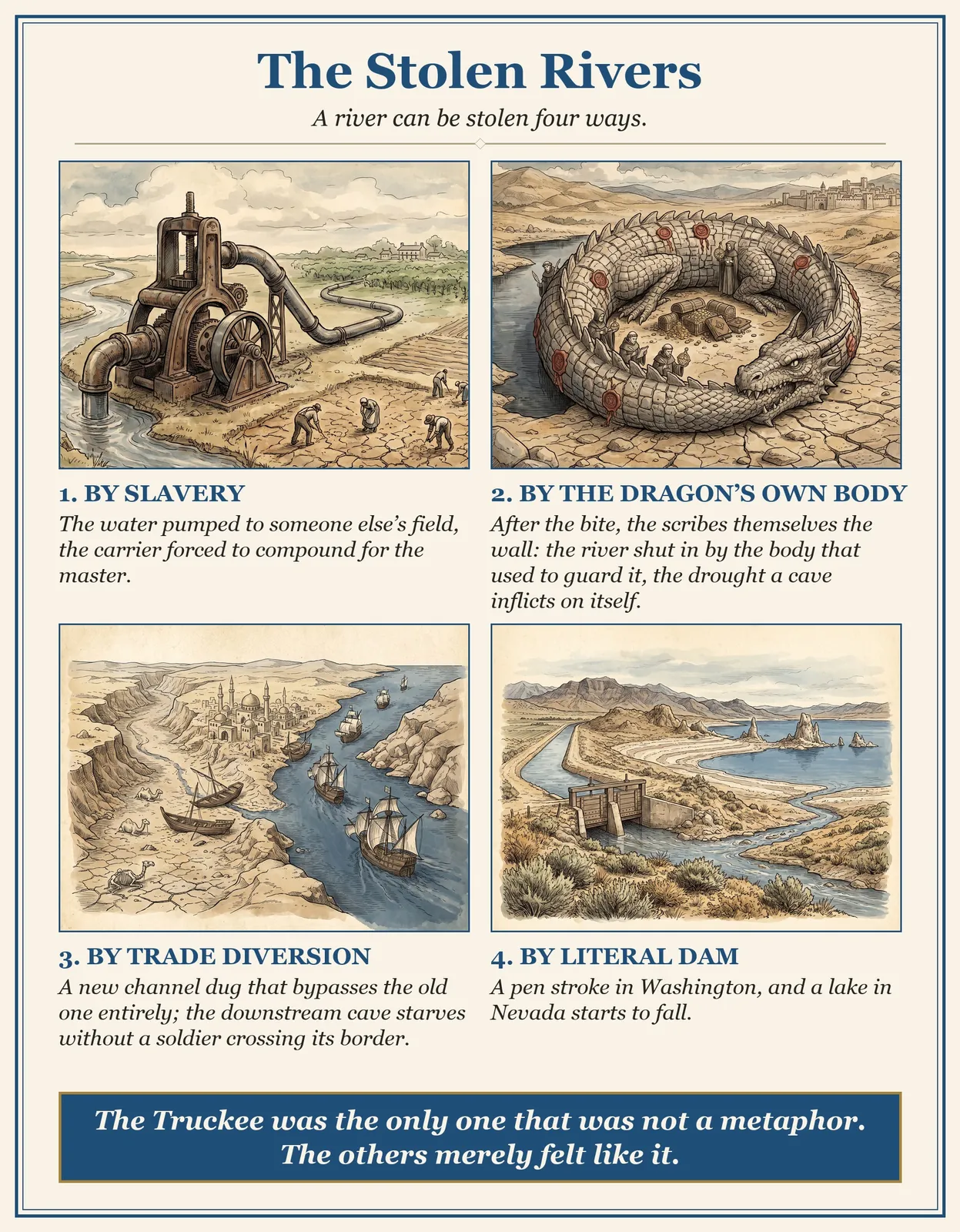
1Slaverypumped to someone else’s field2The dragon’s own bodythe drought a cave inflicts on itself3Trade diversiona new channel bypasses the old4Literal dama pen stroke, and a lake fallsUPSTREAMDOWNSTREAM
  1. 1. Slavery: pumped to someone else’s field
  2. 2. The dragon’s own body: the drought a cave inflicts on itself
  3. 3. Trade diversion: a new channel bypasses the old
  4. 4. Literal dam: a pen stroke, and a lake falls
“There is a word for a river running lower, whatever lowers it, and the word is drought.” A river can be stolen four ways: by slavery, by the dragon’s own body, by trade diversion, and by literal dam. The Truckee was the only one that was not a metaphor (Chapter 11).
RiverAuthor’s Note
Not the Tigris. The river is the people and the surplus they carry, all running together as one current. The river belongs to the people, and it runs whoever sits at the gate.
SurplusPrologue
More than the people standing in the river can eat. Where the river runs long enough over stable ground, surplus washes up, and wherever it collects long enough to be worth sorting, a dragon forms to sort it. River to surplus to cave is the first cycle, older than writing.
GeographyPrologue
The ground the river runs over, the landscape that decides where surplus pools and a cave forms.
ExampleAqueducts put a million people at Rome on a hill the Tiber alone could never have watered, and a dam on the Colorado put a cave at Las Vegas (Prologue).
CarriersPrologue
Red: the people who hold the knowledge in their heads and their hands and their habits, who know not merely what the text says but what it is for.
ExampleWithin fifteen years of the Allied bombing West Germany was the third-largest economy in the world, because what Germany kept was its carrier class (Chapter 19).
RecordPrologue
Black: the clay, the papyrus, the parchment, the codex, the print run, the server farm. A civilization is solvent when it has both carriers and record. It is exposed when it has one.
ExampleAt Pylos one fire ended a writing system, the scribes dying red in the megaron and the tablets baked black into the clay, and nobody in the Greek world could read Linear B again for 3,200 years (Chapter 1).
TributePrologue
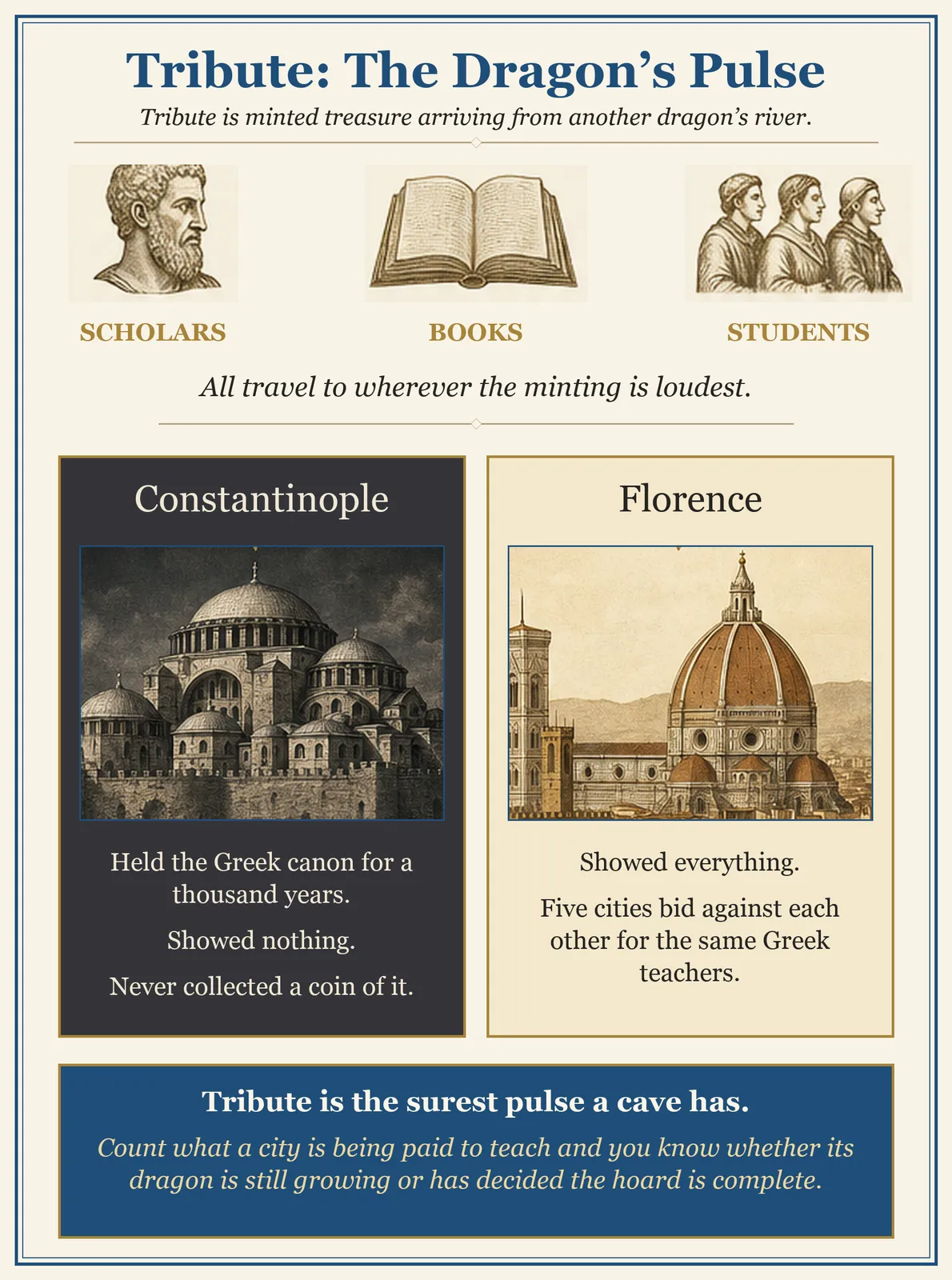
Minted treasure arriving from another dragon’s river: the scholars and the books and the students who travel to wherever the minting is loudest. Count what a city is being paid to teach and you know whether its dragon is still growing.
ExampleBaghdad at its height was paid to teach three continents (Prologue).
Figure 15: Tribute, The Dragon’s Pulse
Stolen riverCh 11
A river taken four ways: by slavery; by the dragon’s own body after the bite; by trade diversion; and by literal dam, the only one that is not a metaphor. The mechanism matters more than the theft.
ExampleThe Thirteenth Amendment, ratified December 6, 1865, returned the stolen river: the water that had been pumped out of one population’s channel for two and a half centuries was released to flow back into the source (Chapter 11).
Figure 13: The Stolen Rivers
Trade diversionCh 11
A new channel dug that bypasses the old one entirely, and the downstream cave starves without a soldier crossing its border.
ExampleDa Gama’s voyage was the greatest trade diversion in the history of the premodern world, and the Mamluk state starved not from attack but from diversion (Chapter 11).
Figure 13: The Stolen Rivers
Literal damCh 11
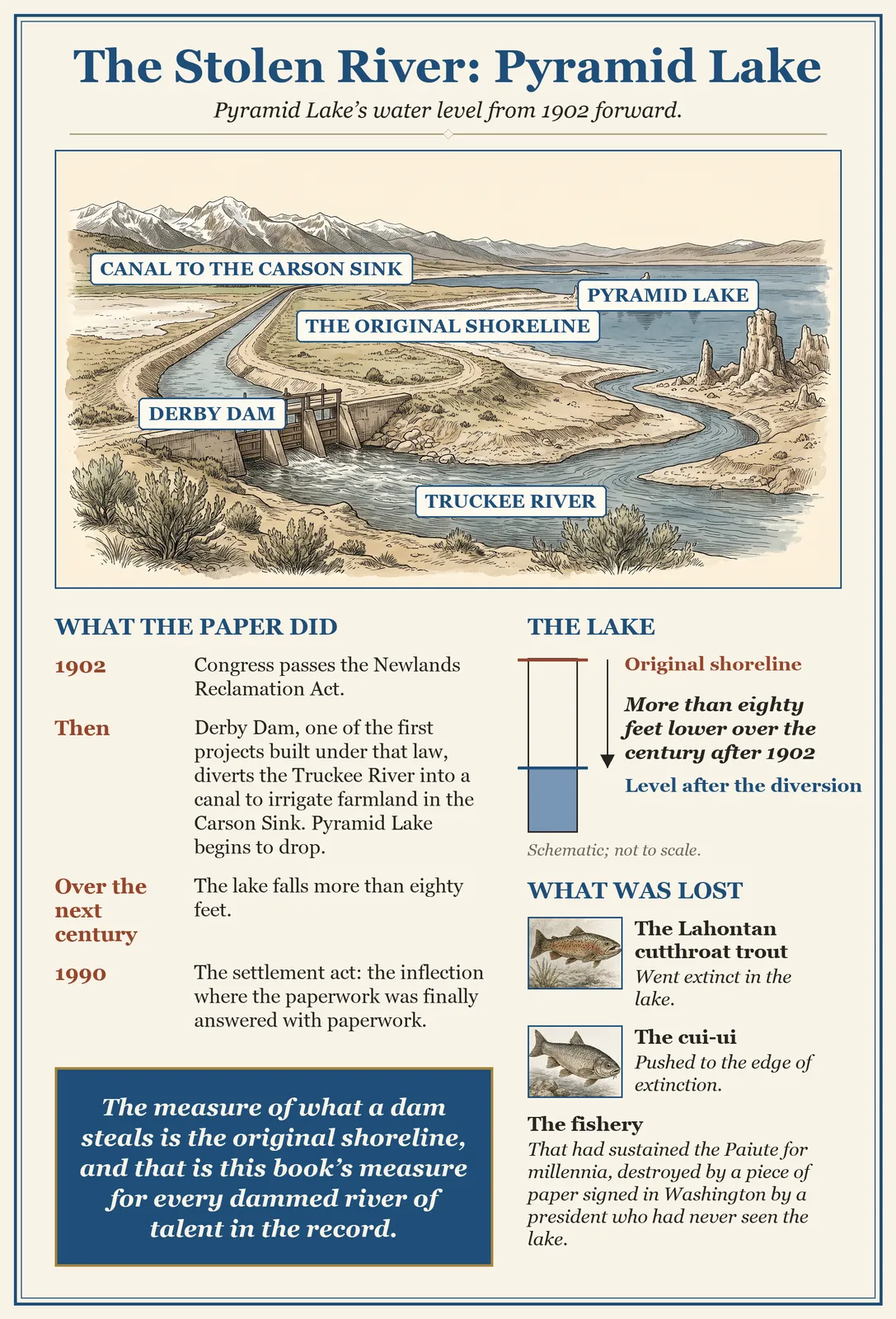
A pen stroke in Washington, and a lake in Nevada starts to fall. The measure of what a dam steals is the original shoreline.
ExampleDerby Dam diverted the Truckee under the Newlands Reclamation Act, and Pyramid Lake fell more than eighty feet over the following century (Chapter 11).
Figure 14: The Stolen River
Pipeline and networkCh 10
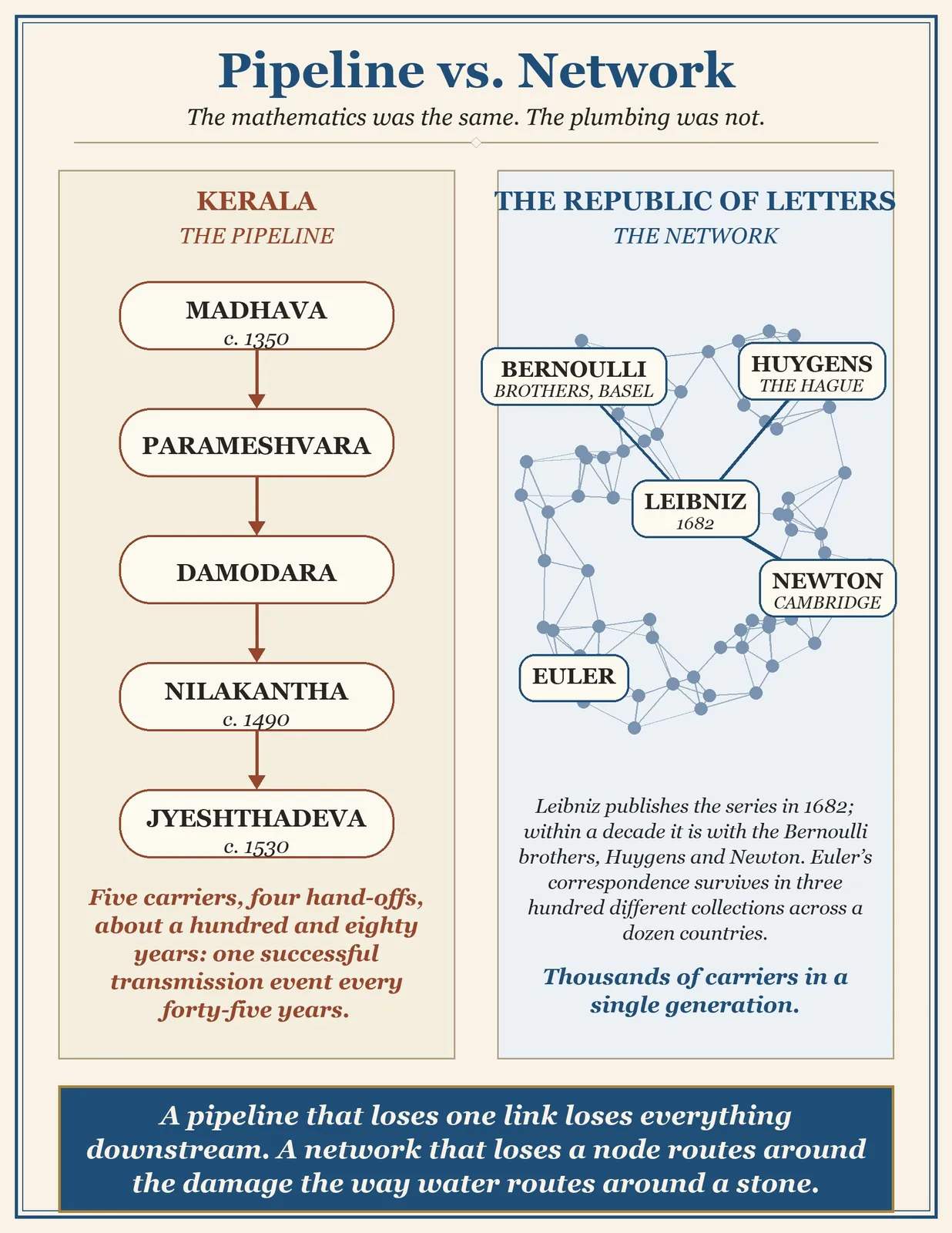
A pipeline that loses one link loses everything downstream. A network that loses a node routes around the damage the way water routes around a stone.
ExampleKerala had five carriers across about a hundred and eighty years; the Republic of Letters had thousands in a single generation (Chapter 10).
Figure 12: Pipeline vs. Network

06 · Spears, gilt, bread, treasure

The Four Piles

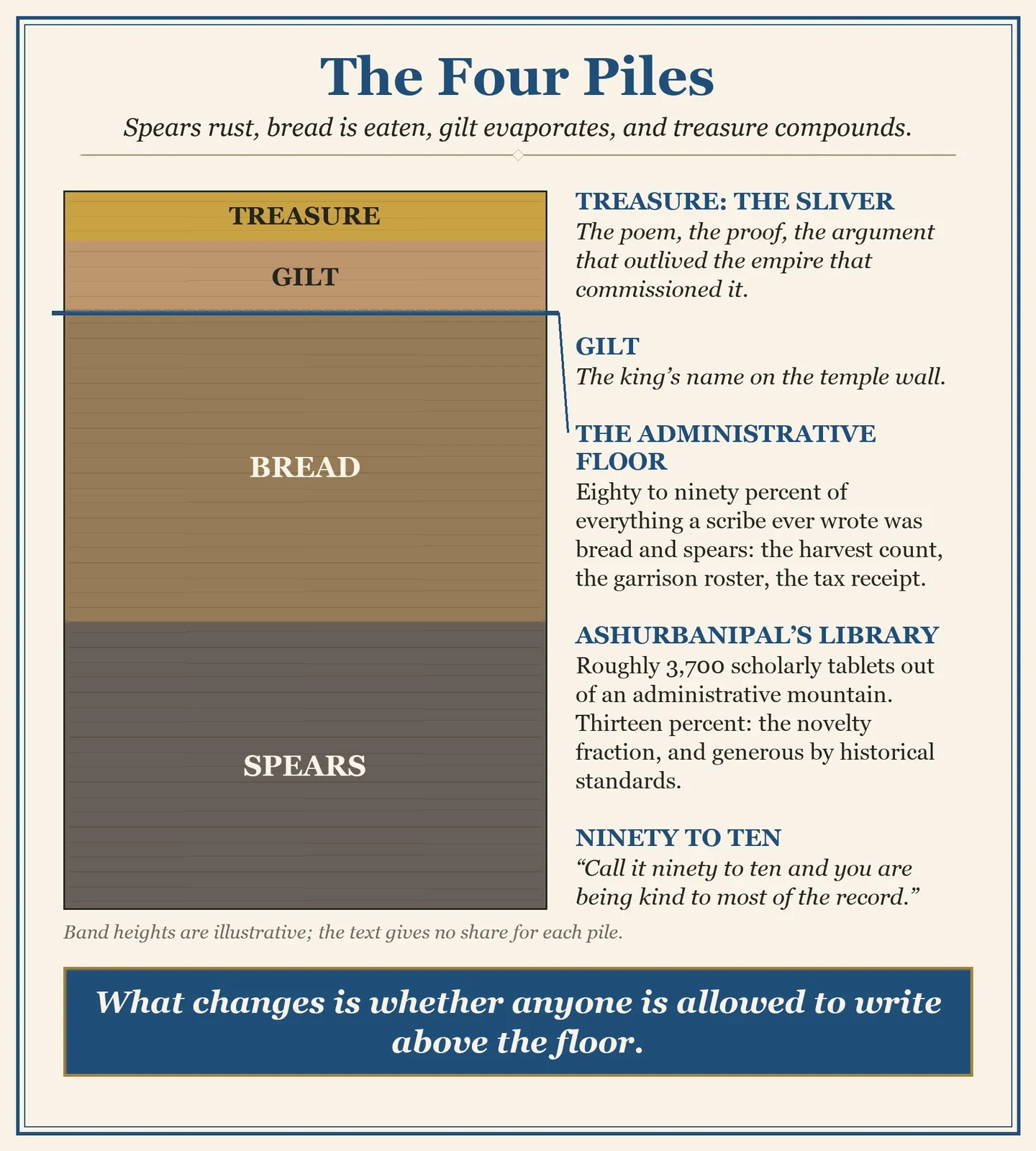
The dragon breathes on the surplus. Where the breath lands, the surplus changes state, and four piles form. Learn the four piles’ one asymmetry and half the book is yours.

Where the dragon’s breath lands, the surplus changes state. Four piles form in the dark of the cave, and in the dark they all glitter the same. Spears rust, bread is eaten, gilt evaporates, and treasure compounds. Only treasure compounds.

Jar heights are illustrative; the book gives no share for each pile.

Four pilesPrologue
Where the breath lands, four piles form in the dark of the cave, and in the dark they all glitter the same: spears, gilt, bread, and treasure. Spears rust, bread is eaten, gilt evaporates, and treasure compounds.
ExampleEighty to ninety percent of everything a scribe ever wrote was bread and spears: the harvest count, the garrison roster, the tax receipt (Chapter 8).
Figure 8: The Four Piles
SpearsPrologue
The pile that rusts: soldiers, walls, weapons, the garrison roster.
ExampleThe Horde smelted everything it took into spears, which is why nothing it took ever compounded for it (Chapter 21).
Figure 8: The Four Piles
BreadPrologue
The pile that gets eaten, and the largest in every cave: rations, barley, the administrative floor. The oldest personal name in the human record belongs to the bread pile: Kushim, a barley accountant in Uruk, unless Kushim was his title rather than his name.
ExampleWhat came off Uruk’s forge was mostly bread: the ration, the receipt, the granary under seal (Chapter 1).
Figure 8: The Four Piles
GiltPrologue
The pile that evaporates: courts, palaces, king lists, parades, the king’s name on the temple wall. A king list that opens with a reign of twenty-eight thousand eight hundred years is gilt’s honest opinion of itself.
Figure 8: The Four Piles
TreasurePrologue
The only pile that compounds: knowledge written down and handed forward so that nobody downstream has to start over. The sliver: the poem, the proof, the argument that outlived the empire that commissioned it. The whole story is in what a dragon decides about the fourth pile.
ExampleBaghdad’s zij, the astronomical tables, was treasure three centuries deep: planetary positions computed by one generation, checked against the sky by the next, and handed forward, until it went into the Tigris in 1258 (Prologue).
Figure 8: The Four Piles
MintingPrologue
What an adult dragon does that younger ones cannot: turning surplus into treasure by writing it down and compounding it, building the schools and copying rooms that compound one generation’s knowledge into the next.
ExampleFlorence was already minting when the Byzantine codices arrived, and it breathed on them through a hundred and fifty printing presses (Chapter 7).
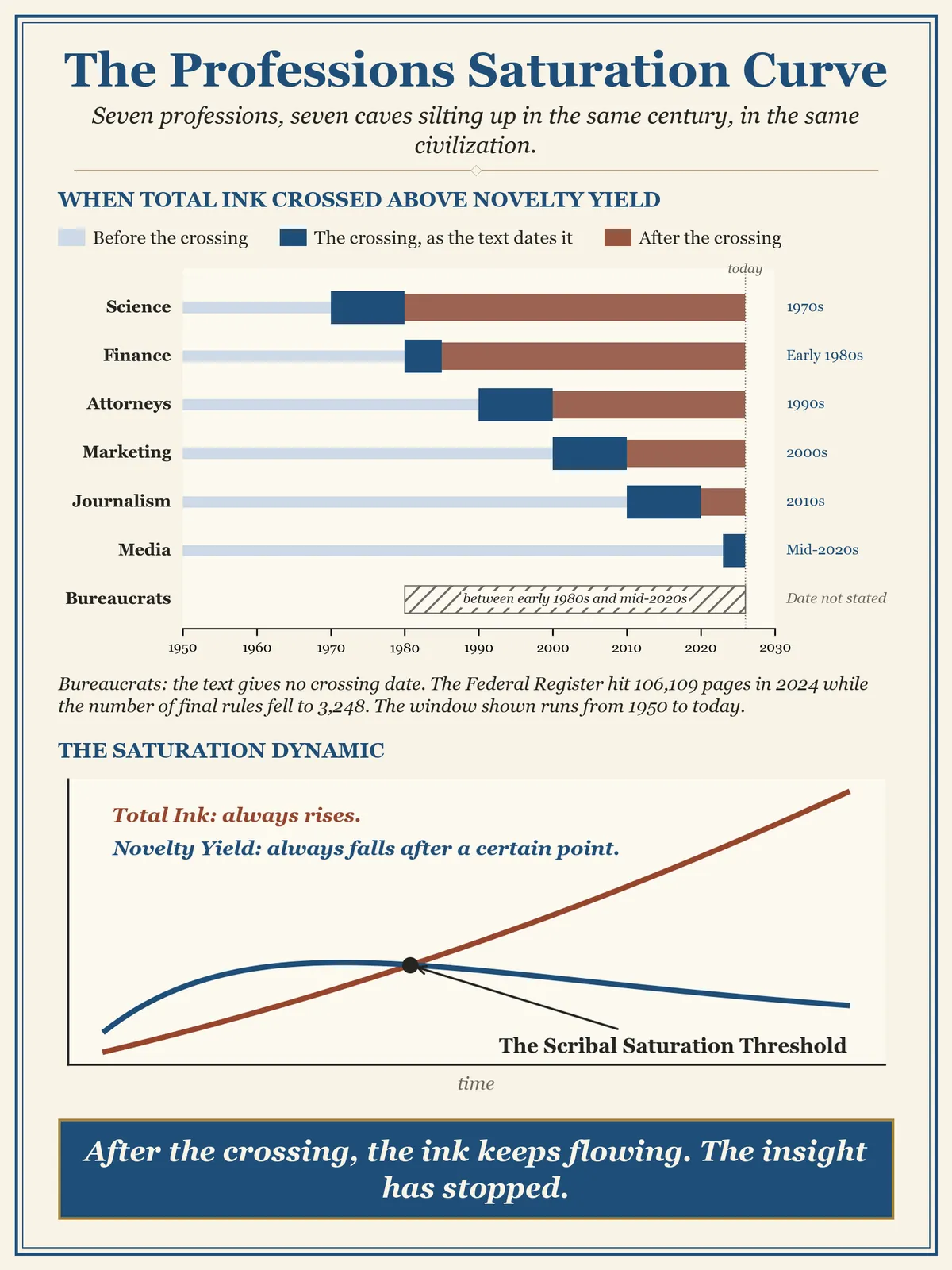
Total InkCh 7
Everything a profession produces: pages, papers, filings, ads. This line always rises.
ExampleUnder the locked Ming format total ink was climbing, more essays, more study guides, more commentaries on commentaries, while what was new in it dropped through the floor (Chapter 9).
Figure 22: The Professions Saturation Curve
Novelty YieldCh 7
The fraction of what a profession produces that says something new about the world: new case law against citations of old case law, original research against papers that cite papers that cite papers. This line always falls after a certain point.
Figure 22: The Professions Saturation Curve
Scribal Saturation ThresholdCh 23
The date Total Ink and Novelty Yield cross: when a profession’s output keeps climbing while novelty drops below the redundancy line. After the crossing, the ink keeps flowing. The insight has stopped.
ExampleScience crossed in the 1970s, finance in the early 1980s, attorneys in the 1990s, and journalism in the 2010s (Chapter 23).
Figure 22: The Professions Saturation Curve
Redundancy lineCh 23
The level a profession’s Novelty Yield falls below at the Scribal Saturation Threshold, while its total output keeps climbing.
Figure 22: The Professions Saturation Curve

07 · What a dragon does, and how it ends

Postures and Fates

The question is what the dragon does with its claws. When an adult dragon ends, the book records how, and there are six ways it has happened. But the scorecard has a blank row, and the blank row is the point.

The six fates, and the blank row

  • Tail spat out

    Tail spat out

    The dragon reforms itself and lets go of what it was hoarding. The only voluntary fate.

  • Dragon slain

    Dragon slain

    Something outside breaks the monopoly and kills the beast. Baghdad, 1258.

  • Dragon scattered

    Dragon scattered

    The cave shatters and survivors carry the hoard downstream to other caves.

  • Ouroboros

    Ouroboros

    The default: the adult curled so far inward that its own body is one round wall around the treasure. Egypt is the oldest case.

  • Cave overflowed

    Cave overflowed

    More carriers rise than the cave can seat, and it breaks from inside without anyone burning a thing.

  • Cave colonized

    Cave colonized

    An alien dragon moves in and replaces the hoard with its own. Cajamarca, taken in an afternoon.

  • No fate

    No fate

    The blank row, and the best one. An open dragon has no fate because it has not ended yet.

Four posturesPrologue
What a dragon does, as distinct from what age it is: open, clenching, the bite, ouroboros. Only an adult can reach the last one, because only an adult has a treasure to guard.
Figure 16: The Dragon’s Postures
OpenPrologue
The first posture: the dragon sorting selectively, the gate doing its work and held wide. Every door wide, tribute flows in, scholars enter freely.
Figure 16: The Dragon’s Postures
ClenchingPrologue
The second posture: the claws tightening on the door as the hoard grows, the body curving around the treasure. A clenching dragon is drawn to bite, but a clenched claw can still be pried open.
ExampleTaqi al-Din’s Istanbul observatory was demolished by state order on January 22, 1580, after the chief mufti declared it an affront to God: a keeper tearing down its own telescope (Chapter 12).
Figure 16: The Dragon’s Postures
FatePrologue
How an adult dragon ends. The book records six ways it has happened: tail spat out, dragon slain, dragon scattered, ouroboros, cave overflowed, and cave colonized.
Figure 2: The Civilization Scorecard
Tail spat outPrologue
When the dragon reforms itself and lets go of what it was hoarding. The only voluntary fate on the list.
Figure 2: The Civilization Scorecard
Dragon slainPrologue
When something outside breaks the monopoly and kills the beast. Baghdad, 1258.
ExampleHulagu Khan’s siege of Baghdad took about two weeks, the eastern wall gave way in the first week of February 1258, and the libraries were emptied into the Tigris (Prologue).
Figure 2: The Civilization Scorecard
Dragon scatteredPrologue
When the cave shatters and survivors carry the hoard downstream to other caves.
ExampleThe fall of Constantinople in 1453 did what a thousand years of internal stasis could not: it scattered the hoard, and the refugees carried the learning to Italy (Chapter 12).
Figure 2: The Civilization Scorecard
Ouroboros (the fate)Prologue
The default fate: an adult that nothing interrupted, curled into one closed ring that sees nothing but itself.
ExampleQianlong refused British trade in 1793 speaking from inside a ring with no door left in it, three centuries after China’s bite in 1487 (Chapter 12).
Figure 2: The Civilization Scorecard
Cave overflowedPrologue
When more carriers rise than the cave can seat, and it breaks from inside without anyone burning a thing. It is the room you are sitting in.
ExampleEducated men turned out faster than the seats could hold: Hong Xiuquan failed the Qing provincial examination four times between 1836 and 1843, and the Taiping Rebellion he started killed roughly twenty million people (Chapter 23).
Figure 2: The Civilization Scorecard
Cave colonizedPrologue
When an alien dragon moves in and replaces the hoard with its own. Cajamarca, taken in an afternoon.
ExampleWithin fifty years of Cajamarca every load-bearing component of the Inca transmission system, the canonical knowledge, the trained carriers and the reproduction mechanism, had been replaced by a Spanish equivalent (Chapter 7).
Figure 2: The Civilization Scorecard
No fatePrologue
The blank row on the scorecard, and the best one: an open dragon has no fate because it has not ended yet. The golden ages are the years a dragon stayed open.
Figure 2: The Civilization Scorecard
Golden agePrologue
The stretches the textbooks call golden ages, the Abbasid translation movement, the Song flowering, the Renaissance, are the years a dragon stayed open: gates wide, treasure compounding, and tribute flowing in.
ScorecardPrologue
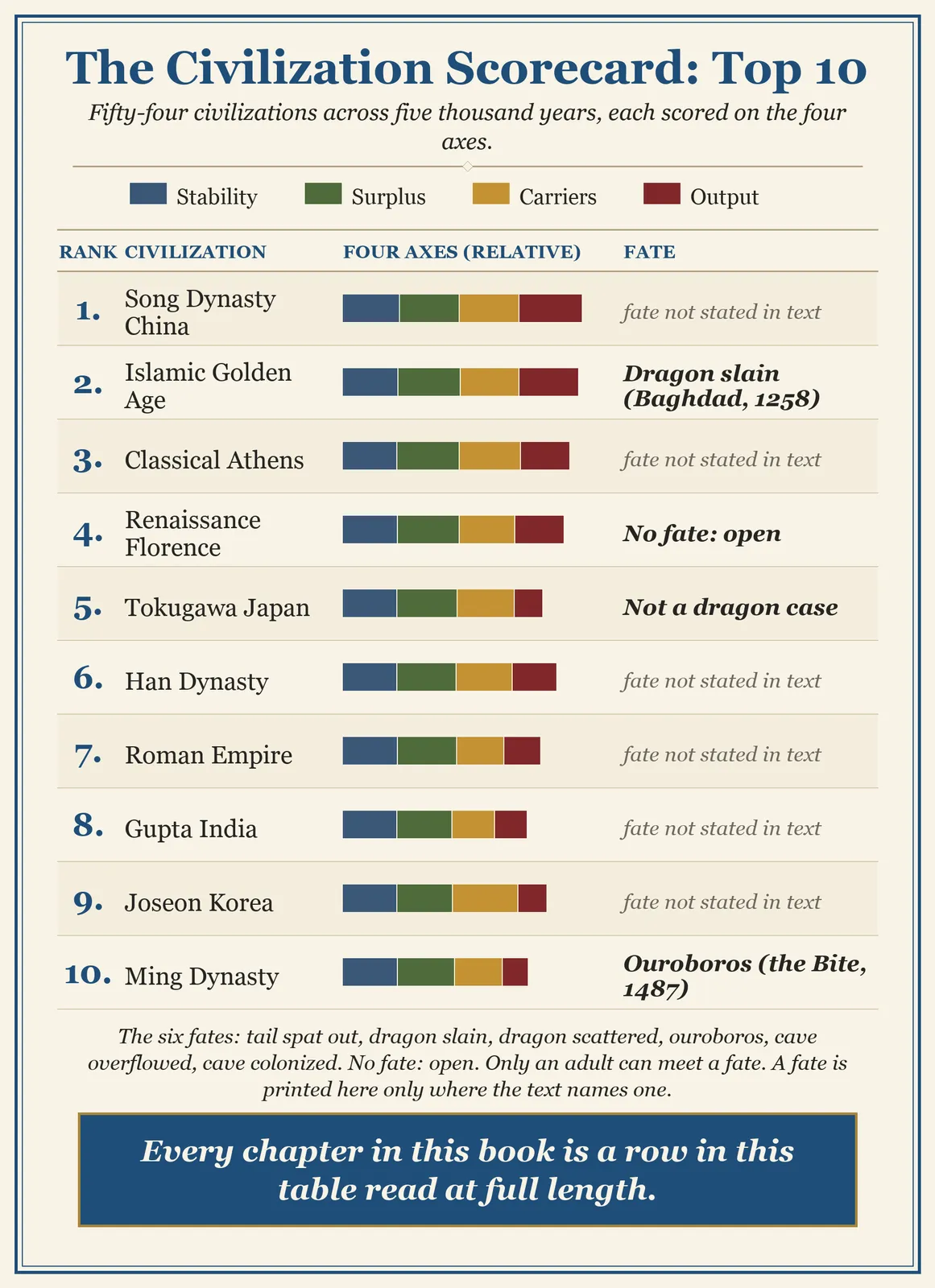
Fifty-four civilizations across five thousand years, each scored on four axes (stability, surplus, carriers, output), checked against the three conditions, and given a fate.
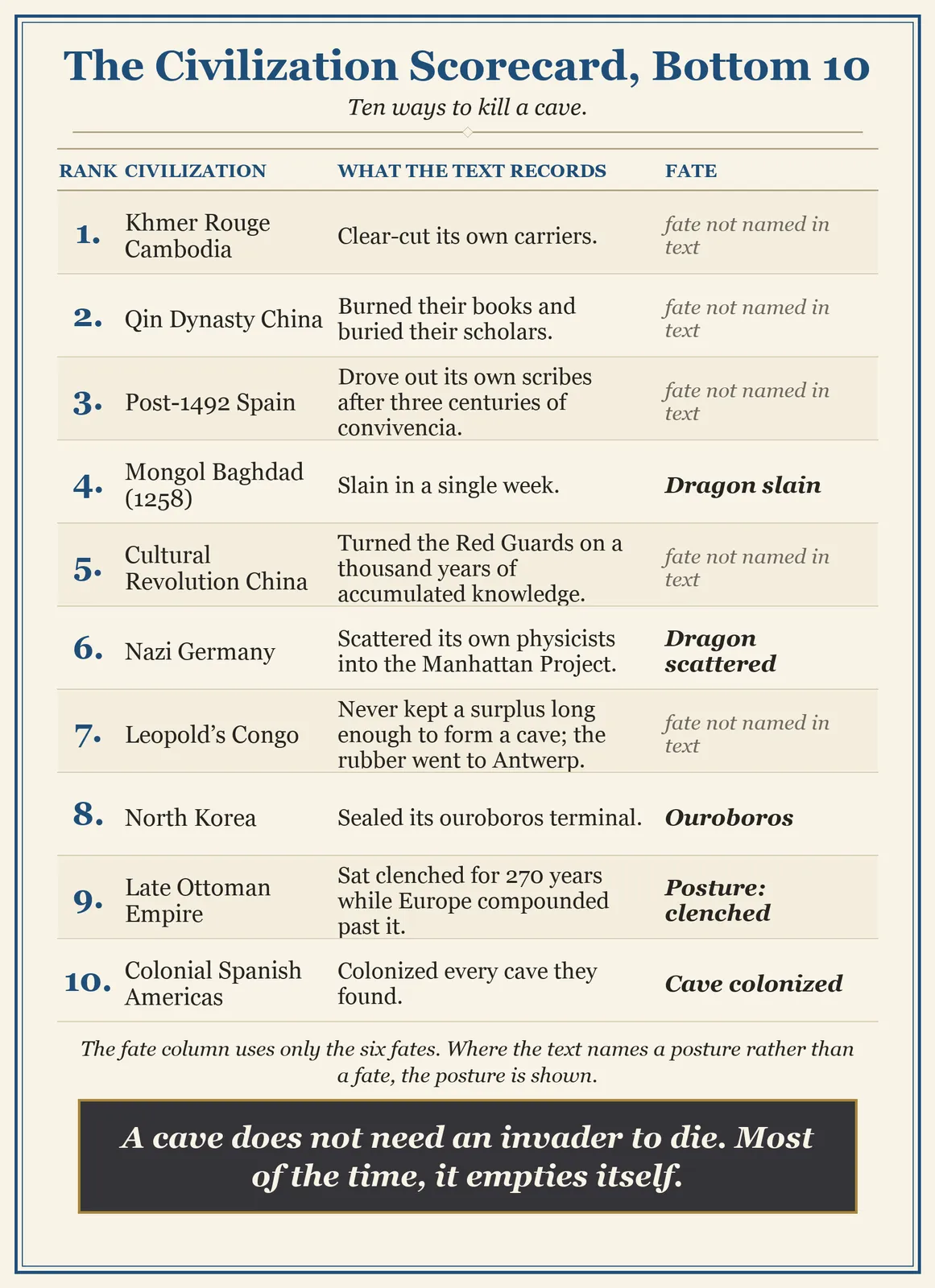
ExampleThe bottom ten includes the Khmer Rouge, which clear-cut its own carriers, and the Late Ottoman Empire, which sat clenched for 270 years while Europe compounded past it (Prologue).
Figure 2: The Civilization Scorecard
Four axesPrologue
Stability, surplus, carriers, output: the four scores every civilization on the scorecard carries, alongside the three conditions.
Figure 2: The Civilization Scorecard
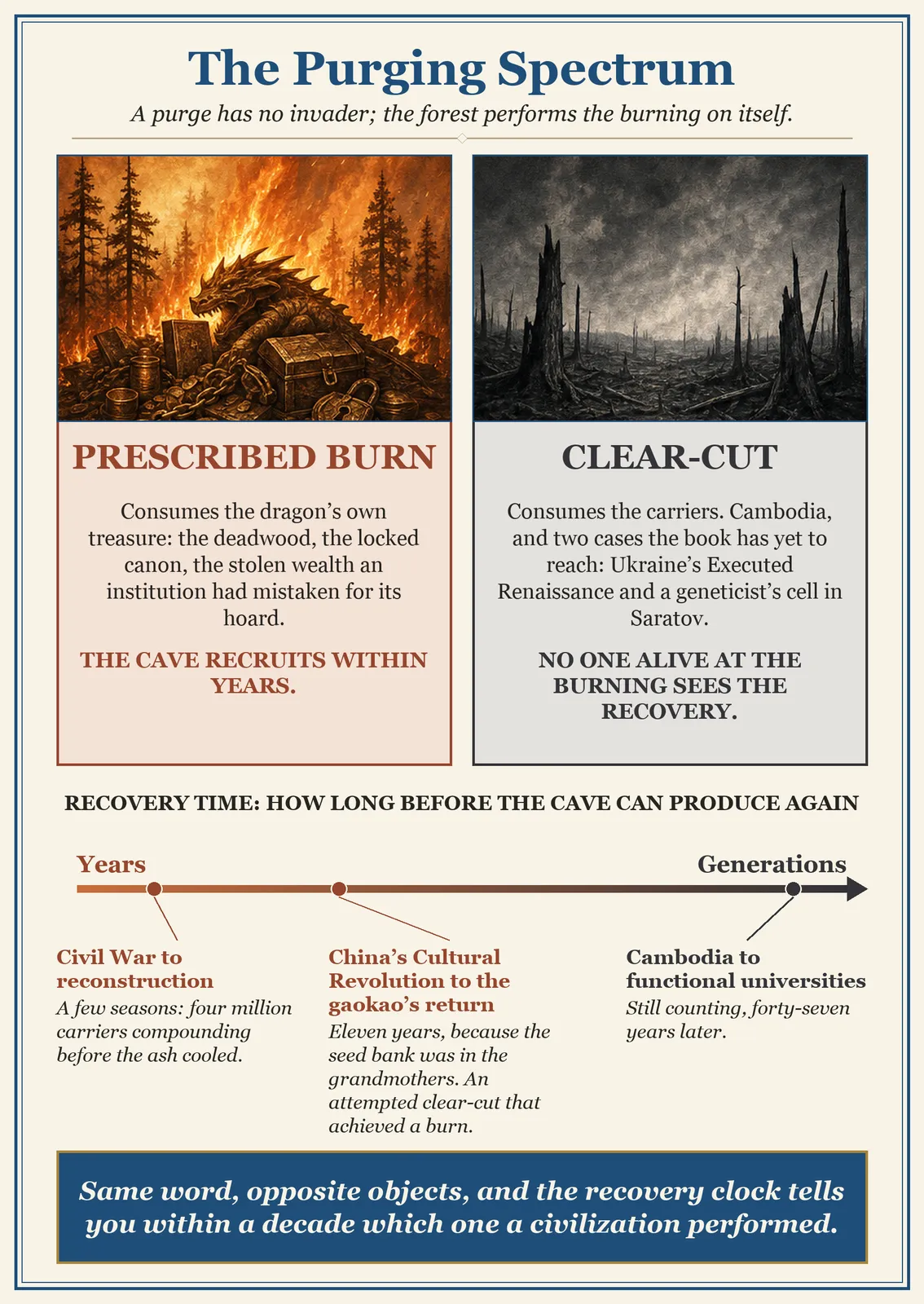
PurgingCh 19
When a state turns on its own people there is no invader; the forest performs the burning on itself. What separates one purge from another is what gets burned, and the recovery time is the measurement.
Figure 19: The Purging Spectrum
BurnCh 19
A fire that removes the standing growth but leaves the roots alive and the seed bank intact beneath the ash. The site regenerates from what survived in place and from what arrives from the edges, and the forest comes back in seasons.
ExampleWithin fifteen years of the Allied bombing, West Germany was the third-largest economy in the world: the professors, engineers and machinists were still alive and carrying their knowledge in their heads (Chapter 19).
Figure 19: The Purging Spectrum
Prescribed burnCh 19
A purge that burns what the old order was hoarding: the deadwood, the locked canon, the stolen wealth an institution had mistaken for its treasure. The country recovers within years.
ExampleThe Civil War burned the richest extraction economy on earth to unlock four million carriers, and the carriers began compounding before the ash cooled (Chapter 19).
Figure 19: The Purging Spectrum
Clear-cutCh 19
A clear-cut removes the seed source itself, and the site depends entirely on what arrives from outside. As a purge, it is the one that consumes the carriers, and no one alive at the burning sees the recovery.
ExampleIn Cambodia the Khmer Rouge closed the schools, destroyed the curriculum and emptied the universities, and the recovery is measured in generations because the soil had been scraped to bare mineral (Chapter 19).
Figure 19: The Purging Spectrum
Managed burnCh 24
Prescribed fire in the range-management vocabulary: a deliberate, controlled disturbance that clears the undergrowth on schedule, before a wild lightning strike can produce an uncontrollable crown fire. A managed burn can reshuffle the deck on schedule. It cannot plan the lucky accident.
ExampleChina is the only country in the book on a managed-burn schedule: every five years the plan rewrites the priorities and clears the calcified industries, while Beijing keeps its hand on the gate (Chapter 24).
Recovery clockCh 19
The measurement of a purge: not what was destroyed, but how long before the cave can produce again.
ExampleFrom China’s Cultural Revolution to the gaokao’s return took eleven years, because the seed bank was in the grandmothers (Chapter 19).
Figure 19: The Purging Spectrum
Fire return intervalCh 7
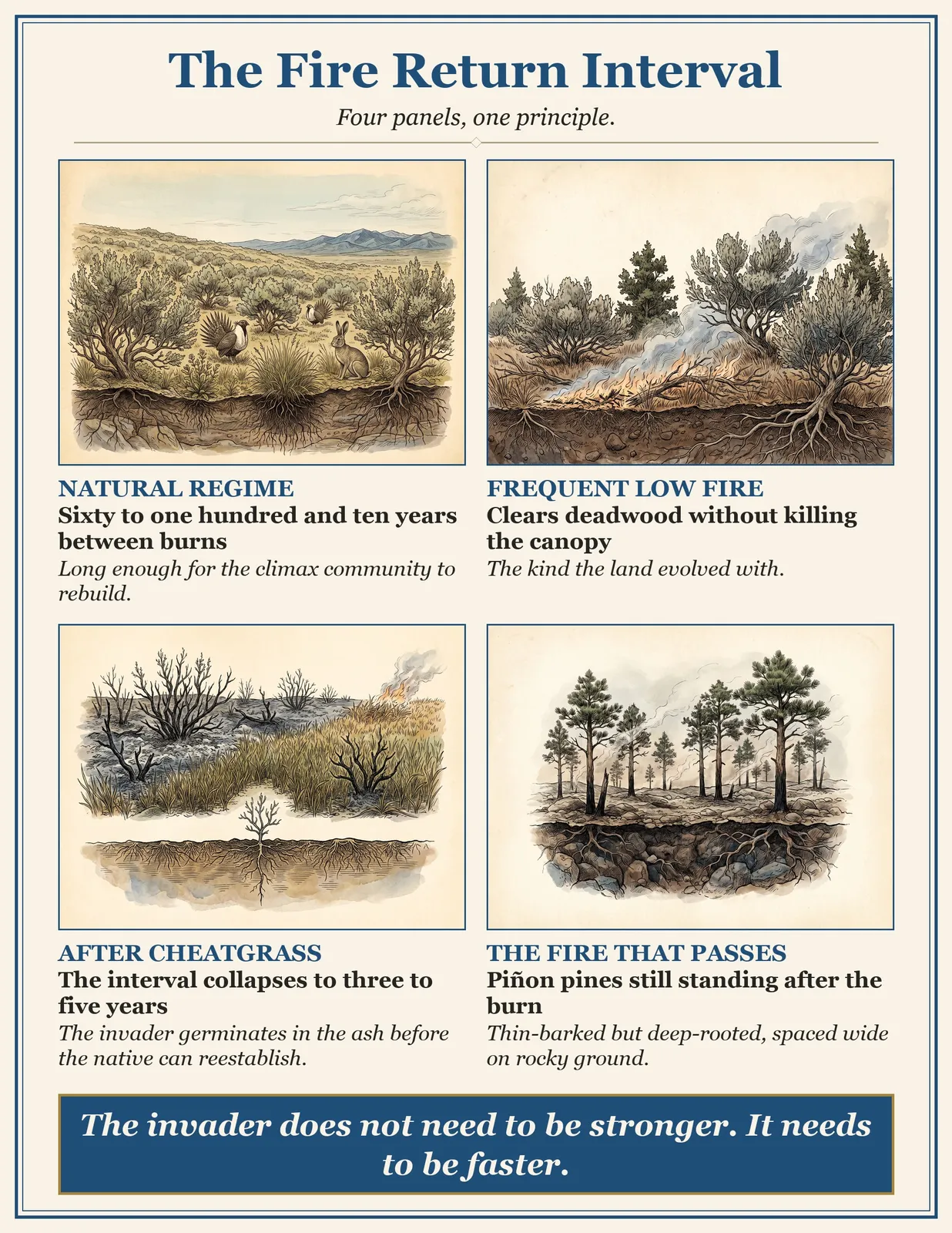
The years between burns. Sagebrush burns every sixty to one hundred and ten years, long enough to reestablish; after cheatgrass, three to five, too fast for the native to grow back.
Figure 5: The Fire Return Interval
InvaderCh 7
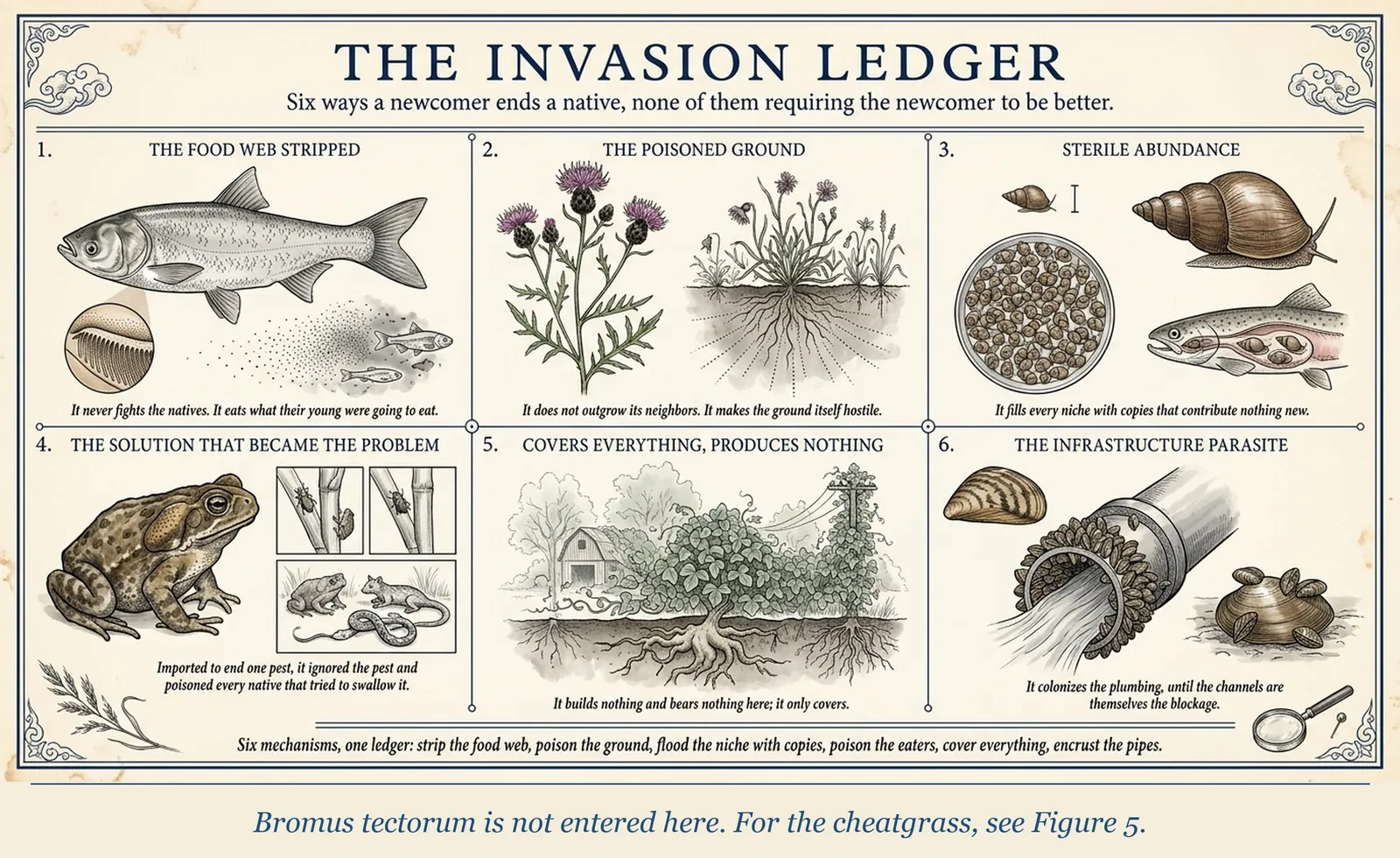
Cajamarca was cheatgrass. The invader does not need to be stronger. It needs to be faster, or more fecund, or simply present when the native is not.
Figure 6: The Invasion Ledger

08 · Figures 1 to 22

The Plates

The twenty-two plates printed in the book, with their figure numbers and captions. Select a plate to open it full size.

  1. Figure 1: The Three Conditions

    Figure 1 · Prologue

    The Three Conditions

    The three conditions that close the dragon’s claw. One: a credentialing monopoly (the keju, the edubba, the bar exam). Two: a self-regulating class (the ulema, the Namboodiri lineages, the medical board). Three: no exit (the Ottoman court, the North Korean state, the Irish monastery).

    Interactive version: /instruments

  2. Figure 2: The Civilization Scorecard

    Figure 2 · Prologue

    The Civilization Scorecard

    The dataset the book keeps pointing to: fifty-four civilizations across five thousand years, each scored on the four axes (stability, surplus, carriers, output) and each checked against the three conditions. The top of the table is where the axes ran together long enough for compounding to take hold, and the fates column records how each hoard ended: tail spat out, dragon slain, dragon scattered, ouroboros, cave overflowed, cave colonized. Every chapter in this book is a row in this table read at full length.

    Interactive version: /scorecard

  3. Figure 3: The Civilization Scorecard, Bottom 10

    Figure 3 · Prologue

    The Civilization Scorecard, Bottom 10

    The other side of the table: ten ways to kill a cave. The Khmer Rouge clear-cut its own carriers. The Qin burned their books and buried their scholars. Post-1492 Spain turned on its own carriers and drove out the scribes who had been compounding for three centuries of convivencia. Mongol Baghdad was slain in a single week. The Cultural Revolution turned the Red Guards on a thousand years of accumulated knowledge. Nazi Germany scattered its own physicists into the Manhattan Project. Leopold’s Congo never kept a surplus long enough to form a cave; the rubber went to Antwerp. North Korea sealed its ouroboros terminal. The Late Ottoman Empire sat clenched for 270 years while Europe compounded past it. And the Colonial Spanish Americas colonized every cave they found. A cave does not need an invader to die. Most of the time, it empties itself.

  4. Figure 4: The Cave Floor, Genetic Evidence

    Figure 4 · Ch 5

    The Cave Floor, Genetic Evidence

    The dragon’s invoice: closure, held long enough, always reaches the genome. The distinction that matters: a dragon-sealed cave carries a second signal, not just that the boundary held, but what the boundary was selecting for.

    Interactive version: /dragons

  5. Figure 5: The Fire Return Interval

    Figure 5 · Ch 7

    The Fire Return Interval

    Four panels, one principle. Top left: a sagebrush steppe under its natural fire regime, sixty to one hundred and ten years between burns, long enough for the climax community to rebuild. Top right: the same landscape under frequent low fire, the kind that clears deadwood without killing the canopy, the kind the land evolved with. Bottom left: the compressed interval after cheatgrass invasion, three to five years, too fast for sagebrush to complete its life cycle, the invader germinating in the ash before the native can reestablish. Bottom right: the fire that passes. A stand of piñon pines still standing after the burn, thin-barked but deep-rooted, spaced wide on rocky ground. The oral tradition is the piñon. The written tradition is the cheatgrass. And the question the book keeps asking is whether the fire that passes leaves anything standing, or whether the invader takes the ground before the native can grow back.

  6. Figure 6: The Invasion Ledger

    Figure 6 · Ch 7

    The Invasion Ledger

    Six invaders, six mechanisms, one pattern. Silver carp: a filter feeder that starves the native food web by consuming the plankton everything else depends on. New Zealand mud snail: a clone army that reproduces asexually and overwhelms every river it enters. Kudzu: a vine that grows so fast it buries the canopy and starves the forest of light. Zebra mussels: a filter organism that colonizes infrastructure and reshapes the water column. Every invasion in this book maps to one of these mechanisms. The Spanish were the cheatgrass. The exam was the knapweed. The printing press was the silver carp of the quipu’s river. The invader does not need to be stronger. It needs to be faster, or more fecund, or simply present when the native is not.

    Caption abridged for the web.

  7. Figure 7: The Windfall Spectrum

    Figure 7 · Ch 7

    The Windfall Spectrum

    What a windfall becomes depends entirely on the cave that catches it. Into a baby’s cave, it buys a century and does not compound: the horse on the plains, the musket in the Bay of Islands. Onto a bitten dragon, it is the one offer that could still make the ring open, and Qianlong turned it away in 1793, three centuries after China’s claw closed, with the cost arriving on warships within half a century. Through an open gate, it amplifies: Florence was already minting when the Byzantine codices arrived, and it breathed on them through a hundred and fifty printing presses. Into a cave with no keeper at the seam, it compounds freely: Perry’s black ships broke two centuries of sakoku and found the terakoya had already built the carriers, with nobody standing between them and the new treasure. Into a clenched claw, it finds the seam grouted shut. One windfall, five caves, five futures.

    Interactive version: /windfall

  8. Figure 8: The Four Piles

    Figure 8 · Ch 8

    The Four Piles

    Eighty to ninety percent of everything a scribe ever wrote was bread and spears: the harvest count, the garrison roster, the tax receipt. Gilt was the king’s name on the temple wall. Treasure was the sliver: the poem, the proof, the argument that outlived the empire that commissioned it. What changes across civilizations is not whether the floor exists. It always exists. What changes is whether anyone is allowed to write above it.

  9. Figure 9: The Anomalies
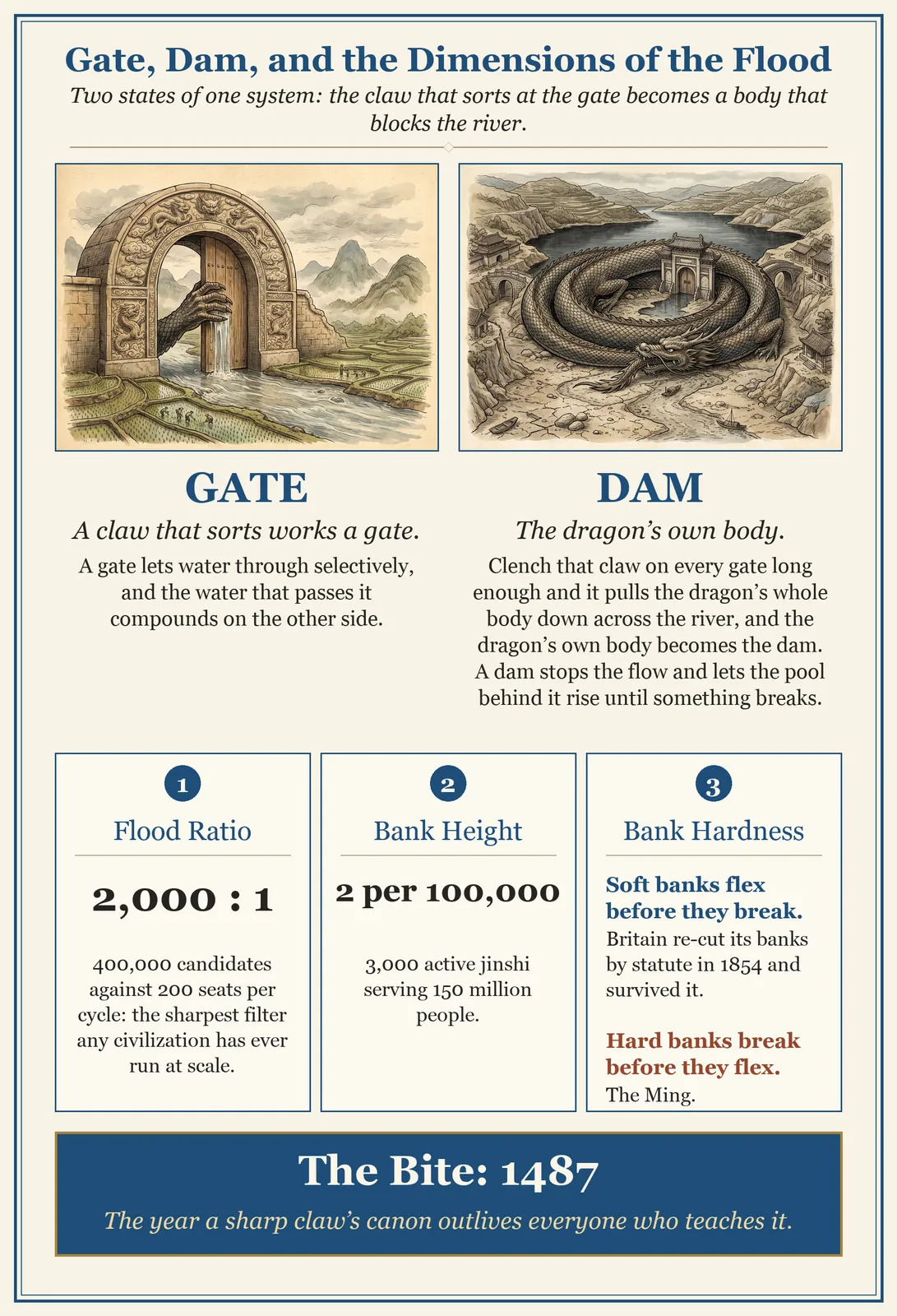
    Figure 9 · Ch 8

    The Anomalies

    Every anomaly in the record shares two traits: a hoard deep enough to compound from, and enough competing caves that no single dragon could seal the door. The depth without the fragmentation is Egypt: three thousand years of preservation, almost no discovery. The fragmentation without the depth is the dark ages: a hundred shallow caves, none deep enough to mint. The combination is the Renaissance, and the combination is rare, and the distance between the upper-right quadrant and every other quadrant on this chart is the distance between compounding and custody.

  10. Figure 10: Gate, Dam, and the Dimensions of the Flood

    Figure 10 · Ch 9

    Gate, Dam, and the Dimensions of the Flood

    The dimensions of the Ming dam: four hundred thousand candidates against two hundred seats per cycle is a flood ratio of two thousand to one, the claw’s sharpness, the sharpest filter any civilization has ever run at scale. Three thousand active jinshi serving a hundred and fifty million is a bank height of two carriers per hundred thousand people. And banks have hardness: soft banks flex before they break (Britain re-cut its banks by statute in 1854 and survived it) while the Ming banks were hard, and hard banks break before they flex. The Bite is the year a sharp claw’s canon outlives everyone who teaches it. China’s date is 1487.

    Interactive version: /river

  11. Figure 11: The Keju Funnel

    Figure 11 · Ch 9

    The Keju Funnel

    Four hundred thousand boys enter. About two hundred pass. The funnel is the gate at its most honest: visible, standardized, and so narrow that the village boy who enters it knows exactly what he is walking into. The gate that does not show you its numbers is the one to worry about.

  12. Figure 12: Pipeline vs. Network

    Figure 12 · Ch 10

    Pipeline vs. Network

    Kerala had five carriers across about a hundred and eighty years. The Republic of Letters had thousands in a single generation. The mathematics was the same. The plumbing was not. A pipeline that loses one link loses everything downstream. A network that loses a node routes around the damage the way water routes around a stone. The question is never whether the knowledge is good enough. The question is whether the corridor exists.

  13. Figure 13: The Stolen Rivers

    Figure 13 · Ch 11

    The Stolen Rivers

    A river can be stolen four ways. By slavery: the water pumped to someone else’s field, the carrier forced to compound for the master. By the dragon’s own body: after the bite, the scribes themselves the wall, the river shut in by the body that used to guard it, the drought a cave inflicts on itself. By trade diversion: a new channel dug that bypasses the old one entirely, and the downstream cave starves without a soldier crossing its border. By literal dam: a pen stroke in Washington, and a lake in Nevada starts to fall. The Truckee was the only one that was not a metaphor. The others merely felt like it.

  14. Figure 14: The Stolen River

    Figure 14 · Ch 11

    The Stolen River

    Pyramid Lake’s water level from 1902 forward: Derby Dam diverted the Truckee under the Newlands Reclamation Act, and the lake fell more than eighty feet over the following century. The 1990 settlement act is the inflection where the paperwork was finally answered with paperwork. The measure of what a dam steals is the original shoreline, and that is this book’s measure for every dammed river of talent in the record.

    Interactive version: /river

  15. Figure 15: Tribute, The Dragon’s Pulse

    Figure 15 · Ch 12

    Tribute, The Dragon’s Pulse

    Constantinople held the Greek canon for a thousand years, showed nothing, and never collected a coin of it; Florence showed everything, and five cities bid against each other for the same Greek teachers.

    Interactive version: /hoard

  16. Figure 16: The Dragon’s Postures

    Figure 16 · Ch 12

    The Dragon’s Postures

    The dragon’s ages and postures. Top row: the four ages the Prologue named. Bottom row: what a dragon does. Gate open: every door wide, tribute flows in, scholars enter freely. Sorting: the gate grows a keeper, some are turned away, the tail begins to curve. Clenching: all gates barred but the last, the tail hovers at the final door, the Ottoman court, 1580. Then the red line: THE MOMENT OF THE BITE. Ouroboros: the dragon is the wall, one closed ring, it sees nothing but itself, Qianlong, 1793. A baby can grow. A young can mature. An adult can choose. Only a wise elder has learned to stay open.

    Interactive version: /hoard

  17. Figure 17: Legacy Persistence

    Figure 17 · Ch 14

    Legacy Persistence

    Legacy: the dragon’s sorting, written into populations and persisting long after the institution that did the sorting is gone. Tay-Sachs clustering in Ashkenazi communities, two thousand years after a rabbinic ordinance about schools; surname concentration in Ming examination districts, centuries after the keju; an 8.5 percent persistence coefficient in Chinese schooling rates, a full century after the exam was abolished; the songbun classification following grandchildren for a mark their grandparents never chose. Each point sits at a different distance from the sorting, and each is still measurable.

    Interactive version: /dragons

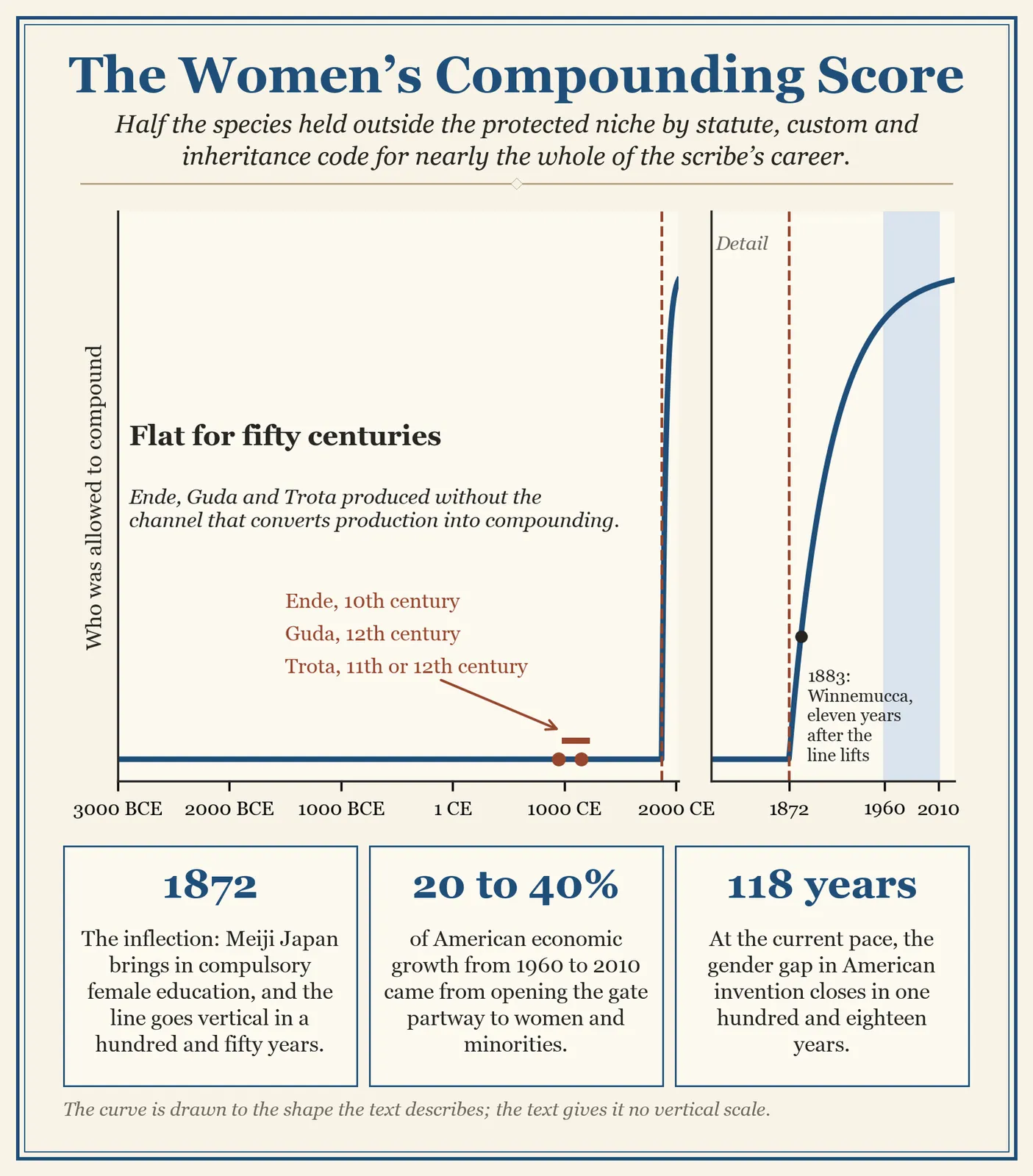
  18. Figure 18: The Women’s Compounding Score

    Figure 18 · Ch 17

    The Women’s Compounding Score

    Who was allowed to compound, civilization by civilization: half the species held outside the protected niche by statute, custom, and inheritance code for nearly the whole of the scribe’s career. The line is essentially flat for fifty centuries (Ende, Guda, and Trota produced without the channel that converts production into compounding) and then goes vertical in a hundred and fifty years, with the inflection sitting exactly on the arrival of mass female schooling in Meiji Japan in 1872. The modern coda: opening the gate partway to women and minorities accounts for twenty to forty percent of American economic growth from 1960 to 2010, and at the current pace the gender gap in American invention closes in one hundred and eighteen years.

    Interactive version: /womens-score

  19. Figure 19: The Purging Spectrum

    Figure 19 · Ch 19

    The Purging Spectrum

    The spectrum runs from burns that recruit within years to clear-cuts that take generations. Civil War to reconstruction: a few seasons; the deadwood burned and the carriers compounded before the ash cooled. China’s Cultural Revolution to the gaokao’s return: eleven years, because the seed bank was in the grandmothers. Cambodia to functional universities: still counting, forty-seven years later, because the soil was scraped to mineral. The recovery clock is the measurement: not what was destroyed, but how long before the cave can produce again.

    Interactive version: /dragons

  20. Figure 20: The Feedback Loop

    Figure 20 · Ch 22

    The Feedback Loop

    Two engines, one design: the output feeds the input, and the cycle no longer needs a reason. Left: the Thaw Engine, the planet’s own ouroboros. Permafrost holds methane. Warming thaws the seal. Methane traps eighty times more heat than carbon dioxide. More heat thaws more permafrost. Right: the Clench Engine, the dragon’s own weather. The hoard grows valuable. Gatekeepers appear. Knowledge stops compounding. Restriction breeds more restriction. Neither cycle needs malice. Neither one stops on its own. The only variable is whether something interrupts.

  21. Figure 21: The Three Sediments

    Figure 21 · Ch 23

    The Three Sediments

    The diagnosis depends on which sediment filled the cave (muck points to the institution, silt to the river, rot to the clock) and mistaking one for another prescribes the wrong cure.

    Interactive version: /hoard

  22. Figure 22: The Professions Saturation Curve

    Figure 22 · Ch 23

    The Professions Saturation Curve

    The crossings cluster inside living memory. Science: 1970s. Finance: early 1980s. Attorneys: 1990s. Marketing: 2000s. Journalism: 2010s. Media: mid-2020s. Each profession hit the same threshold: the date its total output kept climbing while the fraction that said something new about the world fell below the redundancy line.

    Interactive version: /professions

09 · The whole vocabulary

A to Z

Every term in the guide, alphabetized, with the chapter where it first appears and the plate that draws it.

88 of 88 entries

A

Adult dragonPrologue
The third age, defined by one thing: treasure. The moment a dragon starts minting, writing things down and building the schools and copying rooms that compound one generation’s knowledge into the next, it has crossed the threshold, and there is no crossing back. The adult is where the choice lives: leave its gates open, or start limiting who is allowed to compound.
ExampleUruk was a young dragon the morning it started counting; the day the count outlived the counter, it crossed, and became the first adult in the record (Chapter 1).
Figure 16: The Dragon’s Postures
AnomalyCh 8
Every anomaly in the record shares two traits: a hoard deep enough to compound from, and enough competing caves that no single dragon could seal the door.
ExampleThe depth without the fragmentation is Egypt, the fragmentation without the depth is the dark ages, and the combination is the Renaissance (Chapter 8).
Figure 9: The Anomalies
B

Baby dragonPrologue
The first age. It breathes on bread and spears and nothing else: a leader, a structure, maybe a religion, and no pile worth sorting beyond the next meal and the next fight. When a baby loses its river it gets no line on the scorecard; it did not meet a fate, it never formed.
ExampleThe Comanche took the horse from Spanish stock and built a mounted empire the size of modern France, but a warrior who found a better way to break a horse could teach it only by riding alongside his sons (Chapter 7).
Figure 16: The Dragon’s Postures
Baby’s caveCh 7
The cave of a dragon with no treasure pile. A windfall that lands in a baby’s cave buys a century and does not compound: the horse on the plains, the musket in the Bay of Islands.
Figure 7: The Windfall Spectrum
Bank hardnessCh 9
Soft banks flex before they break; Britain re-cut its banks by statute in 1854 and survived it. The Ming banks were hard, and hard banks break before they flex.
Figure 10: Gate, Dam, and the Dimensions of the Flood
Bank heightCh 9
Carriers against the people they serve. Three thousand active jinshi serving a hundred and fifty million is a bank height of two carriers per hundred thousand people.
Figure 10: Gate, Dam, and the Dimensions of the Flood
The bitePrologue
A moment, not a stage: the dragon clamps down and links its body into a ring, and after it the dragon’s own body is the dam. It happens when the knowledge class, the people whose one job was to mint the treasure, takes over the gate from the inside and becomes it. For China the date is 1487, the year the canon outlived every teacher who could still explain why it was written.
ExampleIn 1487 the Eight-Legged Essay became the mandatory examination format, and it was used without interruption until 1901: 414 years of mandated form (Chapter 9).
Figure 10: Gate, Dam, and the Dimensions of the Flood
BreadPrologue
The pile that gets eaten, and the largest in every cave: rations, barley, the administrative floor. The oldest personal name in the human record belongs to the bread pile: Kushim, a barley accountant in Uruk, unless Kushim was his title rather than his name.
ExampleWhat came off Uruk’s forge was mostly bread: the ration, the receipt, the granary under seal (Chapter 1).
Figure 8: The Four Piles
BreathPrologue
What every dragon does from the day it is born: the warmth of a body that has eaten well, the productive use of what the river brought. It is nothing sinister. Where the breath lands, the surplus changes state.
ExampleAt Uruk the barley needed counting, the count needed a mark, and the mark outlived the barley: the breath fell on the ledger because the ledger was where the grain was (Chapter 1).
BurnCh 19
A fire that removes the standing growth but leaves the roots alive and the seed bank intact beneath the ash. The site regenerates from what survived in place and from what arrives from the edges, and the forest comes back in seasons.
ExampleWithin fifteen years of the Allied bombing, West Germany was the third-largest economy in the world: the professors, engineers and machinists were still alive and carrying their knowledge in their heads (Chapter 19).
Figure 19: The Purging Spectrum

C

CarriersPrologue
Red: the people who hold the knowledge in their heads and their hands and their habits, who know not merely what the text says but what it is for.
ExampleWithin fifteen years of the Allied bombing West Germany was the third-largest economy in the world, because what Germany kept was its carrier class (Chapter 19).
CaveAuthor’s Note
The space surplus hollows out where it piles up, and the ground the pile reaches: the territory one dragon sorts. Draw a line around every field whose barley comes through one gate and you have drawn a cave. Every surplus makes one, whether anyone inside it ever writes a word.
Cave colonizedPrologue
When an alien dragon moves in and replaces the hoard with its own. Cajamarca, taken in an afternoon.
ExampleWithin fifty years of Cajamarca every load-bearing component of the Inca transmission system, the canonical knowledge, the trained carriers and the reproduction mechanism, had been replaced by a Spanish equivalent (Chapter 7).
Figure 2: The Civilization Scorecard
Cave floorCh 5
The genome, read as the ground of the cave where the dragon left its mark. The claw marks on the cave floor prove the dragon was real the way nothing else can, because an imaginary beast does not leave dead children.
Figure 4: The Cave Floor, Genetic Evidence
Cave overflowedPrologue
When more carriers rise than the cave can seat, and it breaks from inside without anyone burning a thing. It is the room you are sitting in.
ExampleEducated men turned out faster than the seats could hold: Hong Xiuquan failed the Qing provincial examination four times between 1836 and 1843, and the Taiping Rebellion he started killed roughly twenty million people (Chapter 23).
Figure 2: The Civilization Scorecard
Cave systemPrologue
Caves nest. When a dragon conquers its neighbors their caves open into its own, joined by tunnels that stay open as long as it can hold them. America is the modern case: fifty caves under one dragon, the tunnels held open by a constitution, so that to kill it you would have to collapse every cave at once.
ExampleA thousand years after the first Uruk tablet, Sargon of Akkad took the city caves of the Sumerian plain and connected them into one cave system under one dragon, the first in the record (Chapter 1).
ClawPrologue
The part of the dragon that acts on the gate, opening it and closing it; three conditions close it. Limiting is not a wall, just a claw resting on the door, but it starts a road: as the hoard grows the dragon is drawn to clench. A clenched claw can be pried open. Nobody has ever argued with a wall.
Figure 1: The Three Conditions
Claw marksPrologue
What the dragon’s sorting leaves in the genome: the selection that long closure writes into a population’s DNA, and the genetic diseases that prove it reached that deep. The genome is where the dragon leaves its claw marks, not the forge that does the work.
ExampleThe Samaritans, whose priestly caste has copied its Torah by hand for over 2,500 years, are the smallest cave in the genetic case list and the deepest claw marks: color blindness in roughly a quarter of the men studied (Chapter 5).
Figure 4: The Cave Floor, Genetic Evidence
Clear-cutCh 19
A clear-cut removes the seed source itself, and the site depends entirely on what arrives from outside. As a purge, it is the one that consumes the carriers, and no one alive at the burning sees the recovery.
ExampleIn Cambodia the Khmer Rouge closed the schools, destroyed the curriculum and emptied the universities, and the recovery is measured in generations because the soil had been scraped to bare mineral (Chapter 19).
Figure 19: The Purging Spectrum
Clench EngineCh 22
The dragon’s own weather. The hoard grows valuable. Gatekeepers appear. Knowledge stops compounding. Restriction breeds more restriction.
Figure 20: The Feedback Loop
ClenchingPrologue
The second posture: the claws tightening on the door as the hoard grows, the body curving around the treasure. A clenching dragon is drawn to bite, but a clenched claw can still be pried open.
ExampleTaqi al-Din’s Istanbul observatory was demolished by state order on January 22, 1580, after the chief mufti declared it an affront to God: a keeper tearing down its own telescope (Chapter 12).
Figure 16: The Dragon’s Postures
CorridorCh 4
A connection that carries knowledge between caves. The same connections that carry knowledge carry the shock, and the tighter the ties, the faster the flood travels: a corridor does not check the cargo.
ExampleThe same corridors that had carried the Encyclopédie carried the French Revolution across Europe (Chapter 23).
Figure 12: Pipeline vs. Network
Cultural gatePrologue
A gate made of birth, not effort: the keeper turns you away for what you are. Caste is the pure case; one ancient Indian law text prescribes molten tin poured into the ears of a laborer who overhears the sacred verses. Gender in a plow society is the vast case. The dragon did not build it, but it kept it everywhere, because it is the cheapest gate ever operated.
ExampleIn plow Europe the crop built the body requirement, the body requirement built the inheritance rule, and France’s Salic law barred women from the throne and from inheriting landed property at all (Chapter 2).

D

DamPrologue
The dragon’s own body, after the bite, when it has stopped operating the door and become the barrier itself. The gate and the dam are two states of one system, and the door is still down there somewhere, under the coils.
ExampleThe Ming examination became a dam: every rejected candidate was water with nowhere to go, and the keju dammed the river of a civilization (Chapter 9).
Figure 10: Gate, Dam, and the Dimensions of the Flood
DragonAuthor’s Note
The sorting system itself, born the first day the pile is bigger than the appetite, deciding which mouths the surplus feeds: soldiers, courtiers, clerks and road gangs, or a scribe at a bench. It is not a monster from outside, and not what a preservation system turns into when it goes bad; every society with a pile worth sorting has one. A dragon is not a curse. A dragon is what sorting looks like at scale.
ExampleThe man in Uruk walked a world where the first dragon had just opened its eyes, and the first thing it did was count (Chapter 1).
Figure 16: The Dragon’s Postures
Dragon scatteredPrologue
When the cave shatters and survivors carry the hoard downstream to other caves.
ExampleThe fall of Constantinople in 1453 did what a thousand years of internal stasis could not: it scattered the hoard, and the refugees carried the learning to Italy (Chapter 12).
Figure 2: The Civilization Scorecard
Dragon slainPrologue
When something outside breaks the monopoly and kills the beast. Baghdad, 1258.
ExampleHulagu Khan’s siege of Baghdad took about two weeks, the eastern wall gave way in the first week of February 1258, and the libraries were emptied into the Tigris (Prologue).
Figure 2: The Civilization Scorecard
The dragon’s invoiceCh 5
Closure, held long enough, always reaches the genome. A dragon-sealed cave carries a second signal: not just that the boundary held, but what the boundary was selecting for.
Figure 4: The Cave Floor, Genetic Evidence

F

FatePrologue
How an adult dragon ends. The book records six ways it has happened: tail spat out, dragon slain, dragon scattered, ouroboros, cave overflowed, and cave colonized.
Figure 2: The Civilization Scorecard
Fire return intervalCh 7
The years between burns. Sagebrush burns every sixty to one hundred and ten years, long enough to reestablish; after cheatgrass, three to five, too fast for the native to grow back.
Figure 5: The Fire Return Interval
Flood ratioCh 9
The claw’s sharpness: candidates against seats. Four hundred thousand Ming candidates against two hundred seats per cycle is a flood ratio of two thousand to one.
Figure 10: Gate, Dam, and the Dimensions of the Flood
ForgeCh 1
Where the dragon works the surplus. The only productive fire in this book went out with its smith, Ötzi; every heat after that is breath. What comes off the forge lands on the four piles, and most of it is bread.
ExampleÖtzi had a forge, a real one, charcoal and green rock and copper at 99.7 percent, and when his breath stopped the recipe went into the ice with him: that is the difference between a forge and a dragon (Chapter 1).
Four agesPrologue
Dragons age, and the book keeps track of four ages: baby, young, adult and wise elder. Size does not win: a large young dragon loses to a smaller adult, given time, every time, because compounding outruns scale.
Figure 16: The Dragon’s Postures
Four axesPrologue
Stability, surplus, carriers, output: the four scores every civilization on the scorecard carries, alongside the three conditions.
Figure 2: The Civilization Scorecard
Four pilesPrologue
Where the breath lands, four piles form in the dark of the cave, and in the dark they all glitter the same: spears, gilt, bread, and treasure. Spears rust, bread is eaten, gilt evaporates, and treasure compounds.
ExampleEighty to ninety percent of everything a scribe ever wrote was bread and spears: the harvest count, the garrison roster, the tax receipt (Chapter 8).
Figure 8: The Four Piles
Four posturesPrologue
What a dragon does, as distinct from what age it is: open, clenching, the bite, ouroboros. Only an adult can reach the last one, because only an adult has a treasure to guard.
Figure 16: The Dragon’s Postures

G

GateAuthor’s Note
The door at the mouth of the cave, worked by the dragon’s claw. Its job is not whether treasure gets made at all; its job is what share of the children standing in the river are let anywhere near a bench and a stylus. Every dragon keeps one: an open dragon is not a dragon without a door, it is a dragon holding the door wide.
ExampleAt Uruk the gate came after the hoard: the temple kept a keeper, and the keeper chose who sat behind the ledge and who walked back through the courtyard with an empty donkey (Chapter 1).
Figure 10: Gate, Dam, and the Dimensions of the Flood
GeographyPrologue
The ground the river runs over, the landscape that decides where surplus pools and a cave forms.
ExampleAqueducts put a million people at Rome on a hill the Tiber alone could never have watered, and a dam on the Colorado put a cave at Las Vegas (Prologue).
GiltPrologue
The pile that evaporates: courts, palaces, king lists, parades, the king’s name on the temple wall. A king list that opens with a reign of twenty-eight thousand eight hundred years is gilt’s honest opinion of itself.
Figure 8: The Four Piles
Golden agePrologue
The stretches the textbooks call golden ages, the Abbasid translation movement, the Song flowering, the Renaissance, are the years a dragon stayed open: gates wide, treasure compounding, and tribute flowing in.
Greater sortingCh 8
The dragon’s choice one level up from the gate: whether the extra goes to the writing that breeds, to soldiers, to its own palace, or to the next day’s bread. It is still a sorting of people: deciding where the money goes is deciding which mouths the surplus feeds. Its marks do not fade.
ExampleAn appropriations bill is the greater sorting written down annually, and the NSF line is a record of the sorting you can read without a genome lab (Chapter 20).

H

HardeningPrologue
Gates harden in one direction only: overcomable to cultural to institutional, toll to birth to law. When you see a gate change kinds you are watching a grip begin to close.
ExampleIn the Islamic world the personal ijaza hardened into an institutional credential as the madrasa became the sole channel (Chapter 15).
HoardPrologue
Whatever a dragon is holding in its cave, all four piles together. Only time tells the piles apart, and the dragon does not live on that timescale. It knows one thing: the hoard is bigger than last year.
ExampleConstantinople held the Greek canon for a thousand years, showed nothing, and never collected a coin of it; Florence showed everything, and five cities bid against each other for the same Greek teachers (Chapter 12).
Figure 8: The Four Piles

I

Institutional gatePrologue
The dragon’s own masonry: the dragon decides who sits the exam, writes the questions, and grades the answers. Mesopotamia’s tablet house admitted the sons of governors, priests and scribes; the medieval university charged an entry fee in Latin; imperial China is the type specimen.
ExampleIn medieval Europe the gate itself was the Latin, and the license, and the doctrine that the plow boy did not need to know, and the Church operated it for a thousand years (Chapter 15).
InvaderCh 7
Cajamarca was cheatgrass. The invader does not need to be stronger. It needs to be faster, or more fecund, or simply present when the native is not.
Figure 6: The Invasion Ledger

K

Keju funnelCh 9
Four hundred thousand boys enter. About two hundred pass. The funnel is the gate at its most honest: visible, standardized, and narrow. The gate that does not show you its numbers is the one to worry about.
Figure 11: The Keju Funnel

L

LegacyCh 14
The dragon’s sorting, written into populations and persisting long after the institution that did the sorting is gone.
ExampleChinese schooling rates still carry an 8.5 percent persistence coefficient a full century after the examination was abolished (Chapter 14).
Figure 17: Legacy Persistence
Literal damCh 11
A pen stroke in Washington, and a lake in Nevada starts to fall. The measure of what a dam steals is the original shoreline.
ExampleDerby Dam diverted the Truckee under the Newlands Reclamation Act, and Pyramid Lake fell more than eighty feet over the following century (Chapter 11).
Figure 14: The Stolen River

M

Managed burnCh 24
Prescribed fire in the range-management vocabulary: a deliberate, controlled disturbance that clears the undergrowth on schedule, before a wild lightning strike can produce an uncontrollable crown fire. A managed burn can reshuffle the deck on schedule. It cannot plan the lucky accident.
ExampleChina is the only country in the book on a managed-burn schedule: every five years the plan rewrites the priorities and clears the calcified industries, while Beijing keeps its hand on the gate (Chapter 24).
MintingPrologue
What an adult dragon does that younger ones cannot: turning surplus into treasure by writing it down and compounding it, building the schools and copying rooms that compound one generation’s knowledge into the next.
ExampleFlorence was already minting when the Byzantine codices arrived, and it breathed on them through a hundred and fifty printing presses (Chapter 7).
MuckCh 23
Comes from the dragon: rule and precedent and credential drifting onto the cave floor until the carriers cannot move through it. Muck buries people.
Figure 21: The Three Sediments

N

Nested cavesPrologue
Caves nest. Nevada’s cave sits inside America’s, with its own hoard and its own gates.
ExampleIn 1931 America was forty-eight states, each with its own courts and its own gates, the borders between them held open by a constitution that let a woman carry herself from New York into Nevada on a train ticket (Chapter 3).
No fatePrologue
The blank row on the scorecard, and the best one: an open dragon has no fate because it has not ended yet. The golden ages are the years a dragon stayed open.
Figure 2: The Civilization Scorecard
Novelty YieldCh 7
The fraction of what a profession produces that says something new about the world: new case law against citations of old case law, original research against papers that cite papers that cite papers. This line always falls after a certain point.
Figure 22: The Professions Saturation Curve

O

OpenPrologue
The first posture: the dragon sorting selectively, the gate doing its work and held wide. Every door wide, tribute flows in, scholars enter freely.
Figure 16: The Dragon’s Postures
OuroborosPrologue
The fourth posture and the end of the road: the adult curled so far inward that it is facing its own tail, its own body one round wall around the treasure, nothing in, nothing out. It is not a disaster that befalls a dragon; it is where an adult goes if nothing interrupts it. It is the default, and it is terminal.
ExampleEgypt, the oldest case, kept an unbroken literate tradition for three thousand years and spent the last two thousand of them copying the same training texts, the errors handed down as faithfully as the wisdom (Prologue).
Figure 16: The Dragon’s Postures
Ouroboros (the fate)Prologue
The default fate: an adult that nothing interrupted, curled into one closed ring that sees nothing but itself.
ExampleQianlong refused British trade in 1793 speaking from inside a ring with no door left in it, three centuries after China’s bite in 1487 (Chapter 12).
Figure 2: The Civilization Scorecard
Overcomable gatePrologue
A gate whose toll is high but payable by someone born outside the literate class. It can be beaten or outlived: not the absence of sorting, but sorting with an exit. The Song dynasty sealed the names on every examination paper and had clerks recopy each one so no grader could tell whose it was.
ExampleAbraham Lincoln borrowed the books and was admitted to the Illinois bar in 1836 without a day of law school (Prologue).

P

Pipeline and networkCh 10
A pipeline that loses one link loses everything downstream. A network that loses a node routes around the damage the way water routes around a stone.
ExampleKerala had five carriers across about a hundred and eighty years; the Republic of Letters had thousands in a single generation (Chapter 10).
Figure 12: Pipeline vs. Network
Prescribed burnCh 19
A purge that burns what the old order was hoarding: the deadwood, the locked canon, the stolen wealth an institution had mistaken for its treasure. The country recovers within years.
ExampleThe Civil War burned the richest extraction economy on earth to unlock four million carriers, and the carriers began compounding before the ash cooled (Chapter 19).
Figure 19: The Purging Spectrum
PurgingCh 19
When a state turns on its own people there is no invader; the forest performs the burning on itself. What separates one purge from another is what gets burned, and the recovery time is the measurement.
Figure 19: The Purging Spectrum

R

RecordPrologue
Black: the clay, the papyrus, the parchment, the codex, the print run, the server farm. A civilization is solvent when it has both carriers and record. It is exposed when it has one.
ExampleAt Pylos one fire ended a writing system, the scribes dying red in the megaron and the tablets baked black into the clay, and nobody in the Greek world could read Linear B again for 3,200 years (Chapter 1).
Recovery clockCh 19
The measurement of a purge: not what was destroyed, but how long before the cave can produce again.
ExampleFrom China’s Cultural Revolution to the gaokao’s return took eleven years, because the seed bank was in the grandmothers (Chapter 19).
Figure 19: The Purging Spectrum
Redundancy lineCh 23
The level a profession’s Novelty Yield falls below at the Scribal Saturation Threshold, while its total output keeps climbing.
Figure 22: The Professions Saturation Curve
RefugiaPrologue
The pockets the fire missed: the seed banks, the roots that went deep enough to survive. A society’s scribes are its refugia. When they survive, the civilization regrows.
ExampleTimbuktu’s manuscripts, 350,000 of them smuggled out in footlockers by road and river between 2012 and early 2013, are the modern proof that the refugia mechanism is a thing humans do whenever transmission is attacked (Chapter 12).
RiverAuthor’s Note
Not the Tigris. The river is the people and the surplus they carry, all running together as one current. The river belongs to the people, and it runs whoever sits at the gate.
RotCh 23
Comes from time alone: the parchment that crumbles and the script nobody can still read. Rot needs no current and no dragon, only enough years.
Figure 21: The Three Sediments

S

ScorecardPrologue
Fifty-four civilizations across five thousand years, each scored on four axes (stability, surplus, carriers, output), checked against the three conditions, and given a fate.
ExampleThe bottom ten includes the Khmer Rouge, which clear-cut its own carriers, and the Late Ottoman Empire, which sat clenched for 270 years while Europe compounded past it (Prologue).
Figure 2: The Civilization Scorecard
Scribal Saturation ThresholdCh 23
The date Total Ink and Novelty Yield cross: when a profession’s output keeps climbing while novelty drops below the redundancy line. After the crossing, the ink keeps flowing. The insight has stopped.
ExampleScience crossed in the 1970s, finance in the early 1980s, attorneys in the 1990s, and journalism in the 2010s (Chapter 23).
Figure 22: The Professions Saturation Curve
The scribe’s advantagePrologue
The wall is made of scribes. The scribe is the treasure pile walking around on two legs, and the scribe is also what the wall gets built from. That double identity is the scribe’s advantage, and it is also the scribe’s indictment.
SeamCh 7
The join where knowledge from outside enters a cave. An intact seam lets treasure in without anyone dying for it; a clenched claw grouts it shut.
ExamplePerry’s black ships broke two centuries of sakoku and found the terakoya had already built the carriers, with no keeper at the seam and nobody standing between them and the new treasure (Chapter 7).
Figure 7: The Windfall Spectrum
SiltCh 23
Comes from the river: the text about text a slowing current drops over the treasure, until a reader standing above it concludes there was never any treasure down there at all.
Figure 21: The Three Sediments
SmeltingCh 1
The breath landing on the surplus and changing its state: a heap of barley turned into a mark that outlives the barley, the counter and the temple. Nobody chose it. The temple at Uruk was doing it before anyone inside the walls had a word for it.
SpearsPrologue
The pile that rusts: soldiers, walls, weapons, the garrison roster.
ExampleThe Horde smelted everything it took into spears, which is why nothing it took ever compounded for it (Chapter 21).
Figure 8: The Four Piles
Stolen riverCh 11
A river taken four ways: by slavery; by the dragon’s own body after the bite; by trade diversion; and by literal dam, the only one that is not a metaphor. The mechanism matters more than the theft.
ExampleThe Thirteenth Amendment, ratified December 6, 1865, returned the stolen river: the water that had been pumped out of one population’s channel for two and a half centuries was released to flow back into the source (Chapter 11).
Figure 13: The Stolen Rivers
SurplusPrologue
More than the people standing in the river can eat. Where the river runs long enough over stable ground, surplus washes up, and wherever it collects long enough to be worth sorting, a dragon forms to sort it. River to surplus to cave is the first cycle, older than writing.

T

Tail spat outPrologue
When the dragon reforms itself and lets go of what it was hoarding. The only voluntary fate on the list.
Figure 2: The Civilization Scorecard
Thaw EngineCh 22
The planet’s own ouroboros: permafrost holds methane, warming thaws the seal, and more heat thaws more permafrost. It runs on the same design as the Clench Engine. Neither cycle needs malice. Neither one stops on its own.
Figure 20: The Feedback Loop
Three conditionsPrologue
What closes the claw: the institution controls the credential, the class that holds the credential regulates itself, and there is no exit. Hit all three and the claw closes, every time, and it does not require a single villain.
ExampleMesopotamia met all three: the edubba held a credentialing monopoly, the scribal class policed itself under the man in charge of Sumerian and the man in charge of the whip, and no competing scribal jurisdiction existed (Chapter 8).
Figure 1: The Three Conditions
Three sedimentsCh 23
Muck, silt, and rot. Three sediments settle in a cave, and in this century all three are settling at once. Tell them apart by what they bury.
Figure 21: The Three Sediments
Total InkCh 7
Everything a profession produces: pages, papers, filings, ads. This line always rises.
ExampleUnder the locked Ming format total ink was climbing, more essays, more study guides, more commentaries on commentaries, while what was new in it dropped through the floor (Chapter 9).
Figure 22: The Professions Saturation Curve
Trade diversionCh 11
A new channel dug that bypasses the old one entirely, and the downstream cave starves without a soldier crossing its border.
ExampleDa Gama’s voyage was the greatest trade diversion in the history of the premodern world, and the Mamluk state starved not from attack but from diversion (Chapter 11).
Figure 13: The Stolen Rivers
TreasurePrologue
The only pile that compounds: knowledge written down and handed forward so that nobody downstream has to start over. The sliver: the poem, the proof, the argument that outlived the empire that commissioned it. The whole story is in what a dragon decides about the fourth pile.
ExampleBaghdad’s zij, the astronomical tables, was treasure three centuries deep: planetary positions computed by one generation, checked against the sky by the next, and handed forward, until it went into the Tigris in 1258 (Prologue).
Figure 8: The Four Piles
TributePrologue
Minted treasure arriving from another dragon’s river: the scholars and the books and the students who travel to wherever the minting is loudest. Count what a city is being paid to teach and you know whether its dragon is still growing.
ExampleBaghdad at its height was paid to teach three continents (Prologue).
Figure 15: Tribute, The Dragon’s Pulse
TunnelsPrologue
When a dragon conquers its neighbors, their caves open into its own, and the tunnels between them stay open for as long as it can hold them. When the empire breaks, the tunnels seal and the small caves come back.
ExampleWhen Akkad fell, the tunnels sealed and the city caves came back, each with its own dragon at the mouth again (Chapter 1).

W

WindfallCh 7
Treasure arriving through an intact seam while the source stays whole, which is what a corridor delivers when the seam holds. Nobody died for the Phoenician letters to reach Greece. What a windfall becomes depends entirely on the cave that catches it.
ExampleThe muskets the Ngapuhi chief Hongi Hika carried home after sailing to England in 1820 were a windfall, and in a baby’s cave they bought a century and did not compound (Chapter 7).
Figure 7: The Windfall Spectrum
Wise elderPrologue
The fourth age: an adult that learned to show its treasure and trade from it instead of sitting on it, and built machinery on purpose to keep its own doors open. The Abbasids, the Song, Florence and Alfred’s Wessex each held the age for a while and lost it; Britain in 1854 was the first to make it permanent by statute, and America assembled one by accident. China today is an adult on a managed-burn schedule, not an elder. A wise elder is not immune to the ouroboros; it knows what its tail tastes like.
ExampleBritain looked at China’s examination system and imported only the filter, and that is how the first permanent wise elder was built by statute: not by killing the dragon but by teaching it to breathe with the doors open (Chapter 16).
Figure 16: The Dragon’s Postures

Y

Young dragonPrologue
The second age. It breathes on bread, spears and gilt: palaces, ceremonies, king lists, statues, a court that can look like a civilization in full bloom, and no bench of scribes to carry anything forward. Most of the Bronze Age was young dragons.
ExampleMycenae had gilt enough to fill a grave and never a bench of scribes, and not one of its clerks outlived the fire (Prologue).
Figure 16: The Dragon’s Postures